
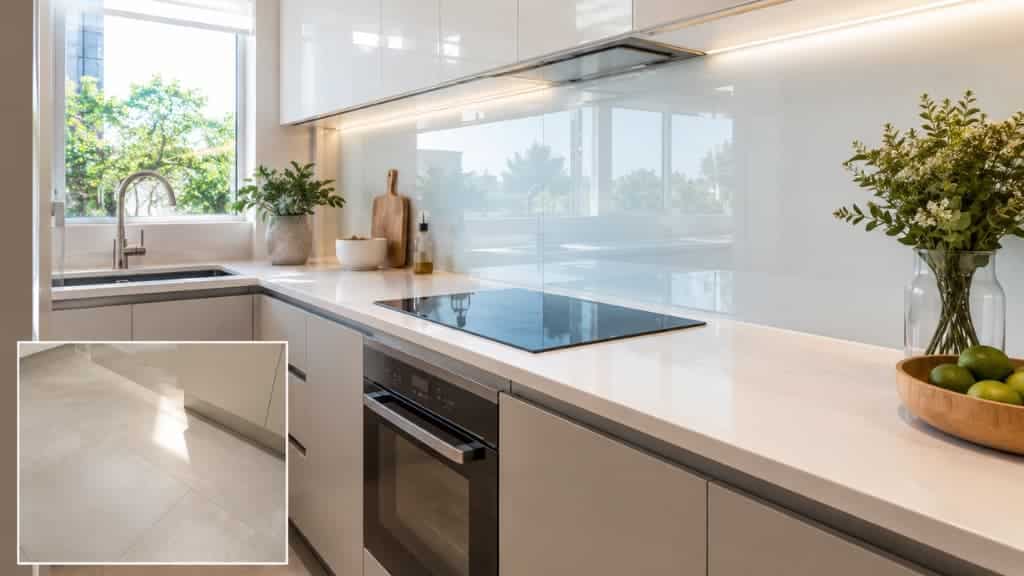
Both glass splashbacks and wall tiles protect your walls and lift the look of a kitchen or bathroom – but they suit different priorities. A glass splashback gives you a seamless, grout-free surface that is the fastest to keep clean and can be colour-matched to almost any shade. Wall tiles offer a wider price range and far more pattern options, from subway to herringbone and mosaic. Glass usually costs more upfront, while tiles take longer to install because each one is laid and grouted.
This guide compares glass splashbacks and wall tiles across cost, cleaning, heat resistance, design, durability and installation, using Australian standards and Melbourne pricing as a reference, so you can choose with confidence.
Glass splashback vs wall tiles: the quick comparison
If you are short on time, the table below summarises how the two options compare across the factors that matter most. Each row is explained in detail further down.
| Factor | Glass splashback | Wall tiles |
|---|---|---|
| Surface & joints | One seamless panel, no grout lines | Multiple tiles with grout joints |
| Cleaning & hygiene | Wipe-down single surface; nothing to harbour grime | Grout needs scrubbing and sealing |
| Upfront cost (AU) | Higher per m2 (made-to-measure) | Wider range – budget to premium |
| Colour & finish | Any RAL/Dulux colour, mirror, printed, metallic | Fixed ranges, patterns and textures |
| Heat behind the cooktop | Yes, when Grade A toughened | Yes, naturally heat-tolerant |
| Installation | Template, toughen, fix single panel | Adhesive + grout; more labour |
| Lead time | Made-to-measure (days-weeks) | Stock tiles are often available now |
| Repairs | Replace the whole panel | Replace an individual tile |
| Durability | Scratch-resistant; will not chip | Can chip or crack per tile |
| Light | Reflects light, brightens a room | More matte, softer look |
| Design style | Modern, minimalist | Classic, subway, mosaic, textured |
| Standards (AU) | AS 1288 & AS/NZS 2208 | AS 1288 for any glass tiles used |
What is a glass splashback?
A glass splashback is a single, made-to-measure panel of toughened glass fixed to the wall behind a benchtop, cooktop or sink. Because it is one continuous sheet, there are no grout lines to stain or seal. Most are back-painted in a solid colour, but they can also be mirrored, printed with a digital image, or made from low-iron (Starphire) glass for the truest colour. Design Inferno makes custom glass splashbacks to order across Melbourne.
Toughened vs annealed glass – why it matters.
Not all glass is suitable for a splashback. A splashback must be made from Grade A toughened (tempered) safety glass, which is heat-treated to be far stronger than ordinary annealed glass and to break into small, blunt pieces if it ever fails. In Australia, glass in buildings is governed by AS 1288, and safety glazing materials are covered by AS/NZS 2208. This is especially important behind a gas cooktop, where the glass must handle heat safely.
What is a tiled splashback?
A tiled splashback is made from individual tiles – usually ceramic, porcelain, glass or natural stone – bonded to the wall with adhesive and finished with grout between each tile. Tiles come in a huge range of formats, including subway, mosaic, herringbone, penny round, large-format and feature tiles, which is why they remain a favourite for classic and textured looks. The trade-off is the grout: every joint needs sealing and ongoing cleaning.
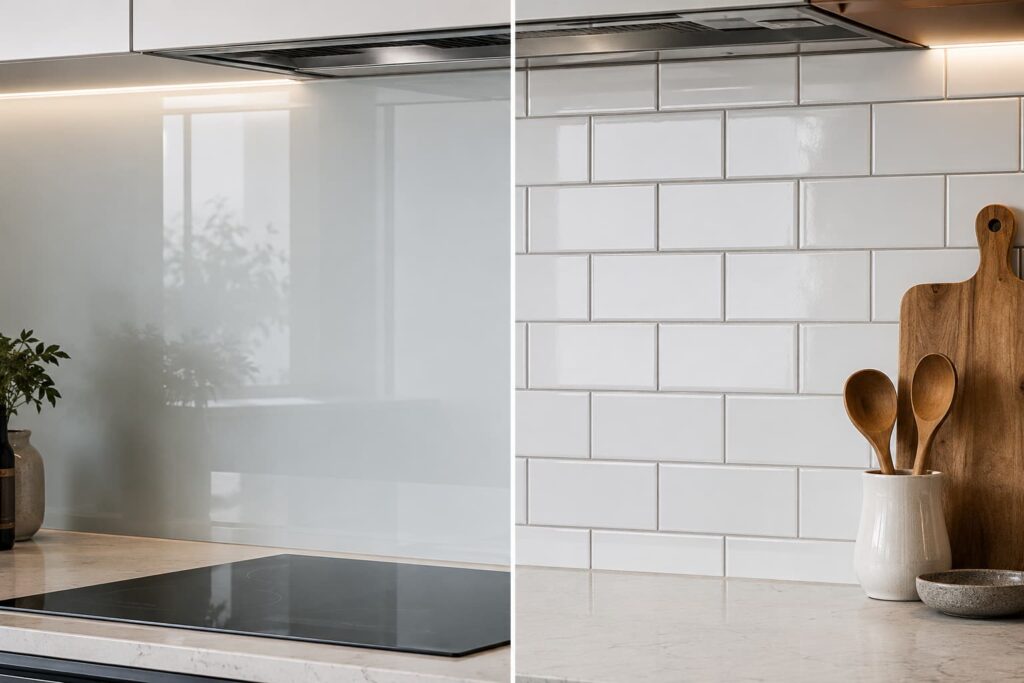
Cost comparison: glass vs tiled splashbacks in Australia
A glass splashback is usually more expensive upfront than a standard tiled splashback, but the gap is smaller than many people expect once tiling labour is included.
As a rough guide, supplied-and-installed glass splashbacks in Australia typically fall between about $400 and $800 per square metre, depending on the colour, glass type and site access. Tiles have a much wider range: budget ceramic tiles can start around $30-$60 per square metre for materials, while premium porcelain, handmade or natural-stone tiles climb well beyond that – and tiling labour (laying, grouting and sealing) usually adds a further $60-$120 per square metre. These figures are indicative only; the accurate way to compare is a measure-and-quote for your exact wall.
Because glass is a single made-to-measure panel, most of the cost is in fabrication rather than on-site labour. Tiles reverse that – cheaper materials, but more hands-on installation time. For a firm price on your kitchen, request a measure and quote.
Cleaning and hygiene: which is easier to maintain?
Glass is the easier of the two to keep clean. A glass splashback is one uninterrupted surface, so oil, sauce splatter and steam wipe away with a soft cloth and glass cleaner – there is no grout to trap grease or grow mould. This makes glass a strong choice directly behind a cooktop or sink, where mess is constant.
Tiled splashbacks are easy to wipe on the tile face, but the grout lines are the weak point. Grout is porous, so it can stain, discolour and harbour mould over time unless it is sealed and cleaned regularly. Darker or epoxy grout helps, but it will never be as low-maintenance as a seamless panel.
Heat resistance: Can you put a splashback behind a gas cooktop?
Yes – you can use either behind a gas cooktop, provided the glass is Grade A toughened safety glass. Toughening lets the panel handle the heat of a gas burner safely, which is exactly why annealed glass is never used for splashbacks. Tiles are naturally heat-tolerant and also perform well.
Whichever you choose, follow the minimum clearance between the burner and the wall specified by your cooktop manufacturer, and make sure the installation meets AS 1288. A professional glazier will confirm the right glass specification for a cooktop location.
Design and colour options
This is where the two really differ. A glass splashback can be colour-matched to almost any RAL or Dulux shade, or finished as a mirror, a metallic, or a printed panel featuring a custom image – giving a smooth, modern, minimalist look. You can preview shades using Design Inferno’s colour simulator before you commit.
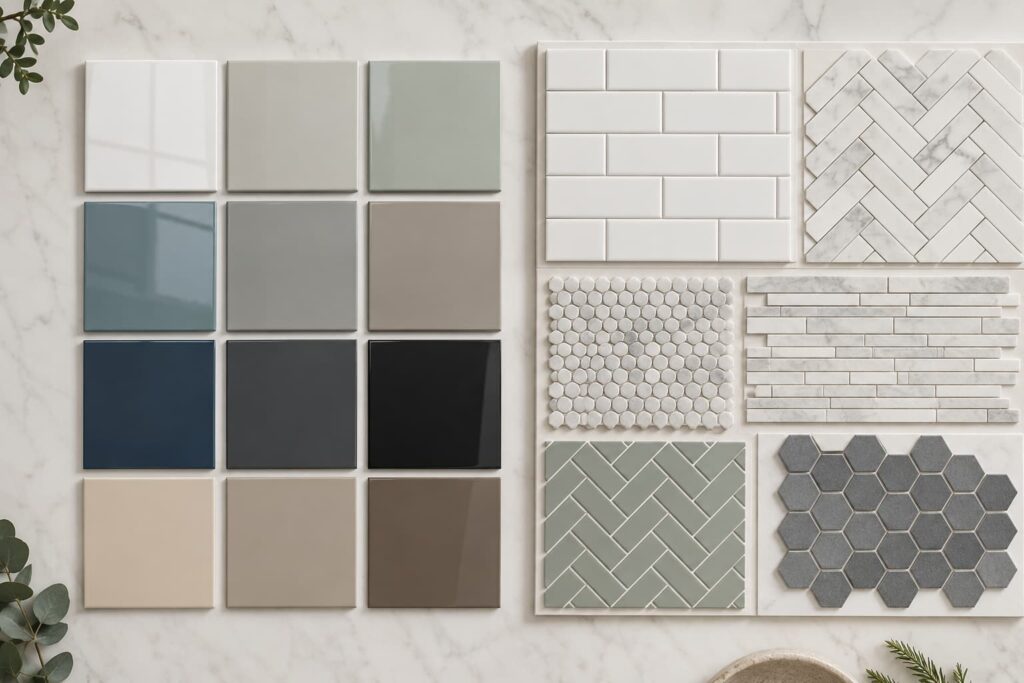
Wall tiles win on pattern and texture. Subway, herringbone, mosaic, penny-round and large-format tiles let you create everything from heritage charm to bold, tactile feature walls. If you love visible detail and a handcrafted feel, tiles are hard to beat.
For something in between, consider a mirrored panel or textured slump glass, or browse finished projects in the Design Inferno gallery for inspiration.
Durability and repairs
Both options are durable and will last for years. The difference is how they fail and how you fix them. Toughened glass resists chipping and will not crack under normal kitchen use, though it can be scratched by abrasive scourers; if a panel is ever damaged, the whole sheet is replaced. Tiles are hard-wearing too, but an individual tile can chip or crack – the upside is that a single damaged tile can be swapped out without redoing the wall, while grout can be re-done to freshen the look.
Installation and lead times
Tiled splashbacks are installed tile-by-tile with adhesive, then grouted and sealed, so they take more on-site time – but stock tiles are often available immediately. A glass splashback is made-to-measure: the glazier templates the wall, the panel is cut, toughened and finished off-site, then fixed to the wall as a single piece. On-site fitting is quick, but allow a lead time of several days to a few weeks for fabrication.
Can a glass splashback be installed over existing tiles?
Often, yes. A glass splashback can sometimes be fixed over existing tiles if the wall is flat and sound, which saves the mess of tearing out the old surface. Glass needs a flat substrate to sit correctly, whereas tiles are more forgiving of minor wall imperfections. A glazier should assess the wall first to confirm it is suitable.
Which is better for a small kitchen?
For a small or low-light kitchen, glass usually has the edge. A single reflective panel bounces light around the room and has no busy grout lines to visually break up the space, which helps a compact kitchen feel larger and brighter. Tiles can absolutely work in a small kitchen, but large areas of dark grout or heavily patterned mosaics can make a tight space feel busier. A light, glossy glass panel – or large-format tiles with minimal grout – is the safer choice when space is limited.
Which lasts longer and adds more value?
Both glass and tiled splashbacks are long-lasting and can add appeal when you sell, so neither is a clear winner on resale alone – it comes down to style and buyer taste. Glass reads as modern and premium, which suits contemporary homes, while quality tiles suit classic, coastal or character properties. Choose the finish that best matches the rest of your kitchen and the feel you want the home to have.
Glass or tiles: how to choose
Use this quick decision guide to settle it:
- Choose a glass splashback if you want the easiest surface to clean, a seamless modern look, an exact custom colour, or more light in a small kitchen.
- Choose wall tiles if you want a wider budget range, visible pattern and texture, a classic or heritage style, or the ability to replace a single damaged piece.
How to measure and order a glass splashback
- Measure the wall area and note any powerpoints, windows or cooktop cut-outs.
- Choose your colour or finish – preview it on the colour simulator first.
- Book a professional template so the panel is cut to the millimetre.
- Allow lead time for the glass to be toughened and finished off-site.
- Have it installed by a qualified glazier who works to AS 1288.
Why choose Design Inferno for your splashback
Design Inferno is a Melbourne glass company with over 15 years’ experience creating custom splashbacks, mirrors, shower screens and balustrades. Every glass splashback is made-to-measure in Grade A toughened safety glass and colour-matched to your kitchen. Preview shades on the colour simulator, see finished work in the gallery, or visit the Keilor Park showroom.
Ready to compare options for your space? Enquire online for a free measure and quote.
Frequently asked questions
Neither is universally better. It depends on your priorities. Glass is easier to clean and looks seamless and modern, while tiles offer more patterns, textures and a wider price range. For low-maintenance kitchens, glass usually wins. For character and design variety, tiles do.
Usually, yes, upfront. Glass typically costs more per square metre than standard ceramic tiles, but once tiling labour and grouting are included, the difference narrows. Premium tiles can even cost more than glass.
Yes. A glass splashback must be made from Grade A toughened safety glass to comply with AS 1288 and AS/NZS 2208, and to be safe behind heat sources such as cooktops.
Yes, as long as it is Grade A toughened glass and installed with the clearances specified by your cooktop manufacturer. Toughened glass is designed to handle the heat of a gas burner safely.
As a rough guide, supplied and installed glass splashbacks generally range from about $400 to $800 per square metre, depending on colour, glass type and site access. The accurate figure comes from a measure and quote for your wall.
Often yes, if the existing wall is flat and sound. Glass needs a flat surface to sit correctly, so a glazier should assess the wall before fitting a panel over old tiles.
Not necessarily. Both can add appeal when selling. The value comes from a quality finish that suits the home, rather than the material itself. Glass suits modern homes, while quality tiles suit classic ones.
Both are long-lasting. Toughened glass resists chips and cracks but is replaced as a whole panel if damaged, whereas individual tiles can crack but can be swapped out one at a time.
