
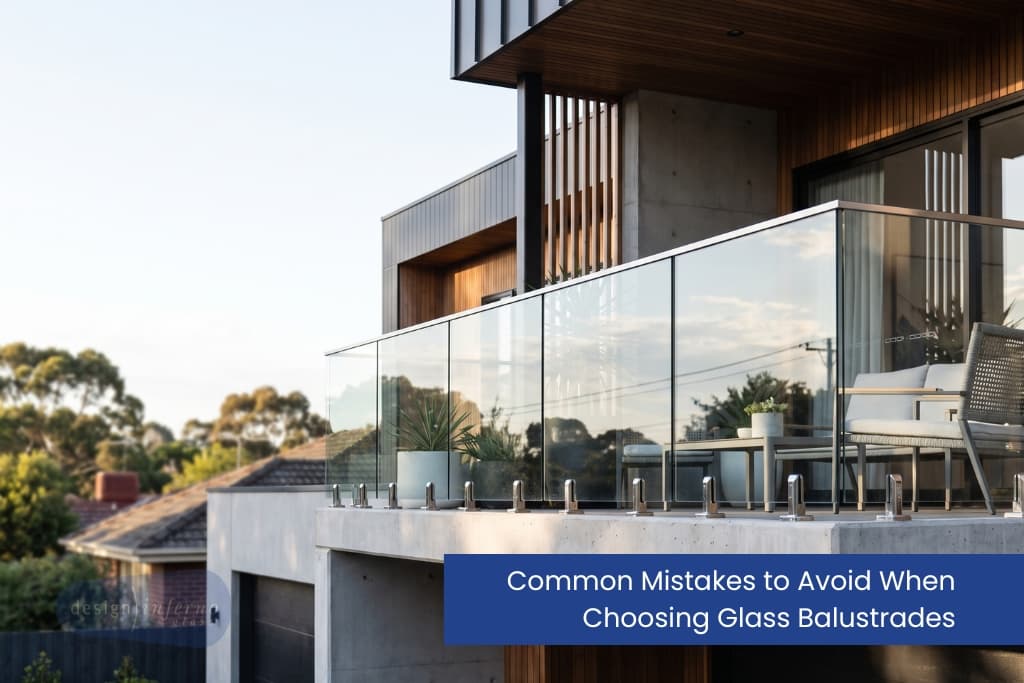
Quick answer Choosing glass balustrades goes wrong when people focus on looks and skip the safety rules. The most common mistakes are ignoring Australian Standard AS 1288, picking the wrong glass type or thickness, forgetting the interlinking handrail, choosing cheap fixings that corrode, poor site measuring, hiring an uncertified installer, and buying on looks alone. Get these right, and you get a safe, clear, long-lasting balustrade.
Key facts (glass balustrades, Australia)
Glass balustrades in Australia must comply with AS 1288:2021 and the National Construction Code.
Barrier glass must be Grade A safety glass — toughened or laminated. Ordinary annealed glass is never allowed.
Minimum barrier height is 1000 mm for balconies and stairs, and 1200 mm around pools deeper than 300 mm.
No gap in the lower barrier may allow a 125 mm sphere to pass through.
Plain toughened glass over 1000 mm needs an interlinking handrail; toughened laminated glass often does not.
Any barrier protecting a fall over 5 metres must use laminated glass.
What are the 7 most common glass balustrade mistakes?
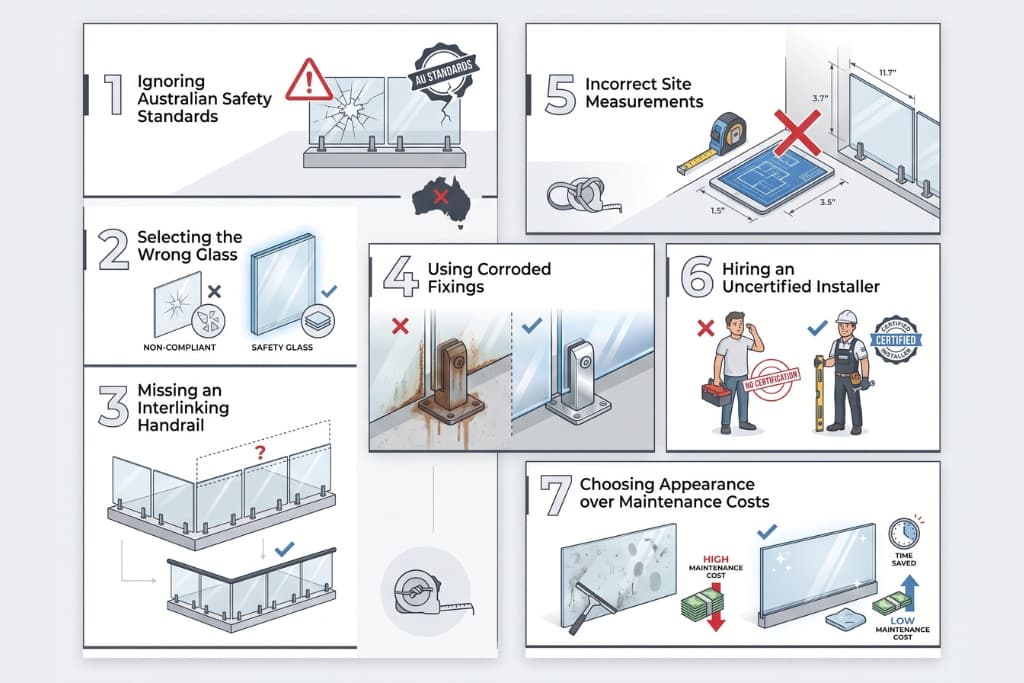
- Ignoring Australian Standards — AS 1288:2021 and the NCC set height, load and glass rules.
- Wrong glass type or thickness — barrier glass must be Grade A safety glass (toughened or laminated).
- Forgetting the interlinking handrail — often required so a broken panel can’t cause a collapse.
- Skimping on fixings — cheap hardware rusts near pools and the coast.
- Poor measuring and site prep — glass is cut to order and can’t be trimmed on site.
- Uncertified installer — no compliance certificate means trouble at inspection or resale.
- Looks over maintenance and cost — frameless is stunning but shows marks and costs more.
What is a glass balustrade?
A balustrade is a safety barrier that stops people falling from a raised edge, such as a balcony, staircase, deck, or landing. A glass balustrade uses toughened or laminated safety glass panels instead of timber or metal rails, so the view stays open.
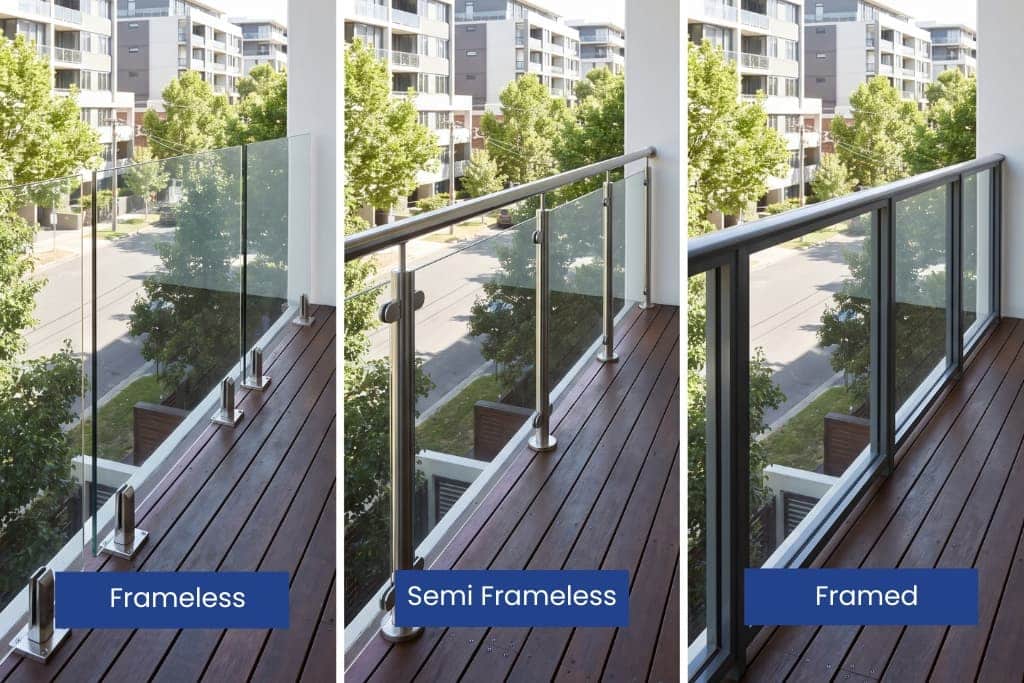
There are three common styles. Frameless uses spigots or a base channel with no posts. Semi-frameless uses slim posts between panels. Framed surrounds each panel with metal. Each has its own cost, look and cleaning needs, which is why the choice matters before you buy. See our frameless glass balustrades range for examples.
Why must glass balustrades meet AS 1288 and the NCC?
This is the costliest mistake. Glass balustrades in Australia must comply with AS 1288:2021 (glass in buildings) and the National Construction Code. Pool barriers follow a separate rule, AS 1926.1.
A few numbers you should know. Most barriers need a minimum height of 1000 mm from the finished floor. Around a pool deeper than 300 mm, the barrier must be at least 1200 mm. In the lower part of the barrier, a 125 mm sphere must not be able to pass through any gap. Skip these, and you may fail inspection, void insurance, or have to rip the job out and start again.
Compliance snapshotRule of thumb: balcony and stair barriers = 1000 mm minimum; pool barriers = 1200 mm minimum; no gap may pass a 125 mm ball.
Height and gap quick reference
| Location | Minimum height | Key gap rule |
|---|---|---|
| Balcony/deck/landing | 1000 mm from floor | 125 mm sphere must not pass |
| Staircase | 1000 mm (865 mm on stair flights) | 125 mm sphere must not pass |
| Pool barrier (>300 mm deep) | 1200 mm from ground | 100 mm sphere; AS 1926.1 applies |
| Fall over 5 m | 1000 mm + laminated glass | Laminated glass mandatory |
Chart opportunity: bar chart of minimum heights (1000 mm balcony vs 1200 mm pool).
Toughened or laminated: which glass is best for a balustrade?
Not all glass is equal. Under AS 1288:2021, balustrade glass must be Grade A safety glass, which means either toughened (tempered) or laminated glass. Ordinary annealed glass is never acceptable in a barrier.
What is the difference between toughened and laminated glass?
Toughened glass is heat-treated to be much stronger and crumbles into small, blunt pieces if it breaks. Laminated glass bonds two sheets with a plastic interlayer, so if it cracks, the pieces hold together like a car windscreen.
The key rule: plain toughened glass for a barrier over 1000 mm needs a handrail. Toughened laminated safety glass can often be used without a top rail because the interlayer holds a broken panel in place. Any barrier protecting a fall over 5 metres must use laminated glass. Thickness is usually 10–12 mm for frameless panels, but always confirm with an engineer for your span and height.
| Feature | Toughened glass | Laminated glass |
|---|---|---|
| How it breaks | Crumbles into small blunt bits | Holds together on the interlayer |
| Handrail needed? | Yes, over 1000 mm | Often no (toughened laminated) |
| Falls over 5 m | Not permitted alone | Required |
| Relative cost | Lower | Higher |
| Best for | Pool fences, low decks with a rail | Frameless, high balconies, no-rail looks |
Do glass balustrades need an interlinking handrail?
Under AS 1288:2021, a structural glass balustrade protecting a fall of one metre or more usually needs an interlinking top rail. This rail connects the panels so that if one pane shatters, the rail bridges the gap and stops the barrier collapsing.
Two things trip people up. First, a small cap on top of a single panel is not an interlinking handrail. Second, the handrail must carry the required loads on its own, without relying on the glass. If you want a clean, rail-free look, that usually means choosing toughened laminated glass instead. Decide this early, because it changes both the price and the appearance.
What fixings and hardware should a glass balustrade use?
The glass gets the attention, but the spigots, brackets, standoffs and channels hold everything up. In coastal or poolside areas, cheap hardware rusts fast. Salt air and chlorine attack low-grade steel within a season or two.
Choose marine-grade 316 stainless steel near the coast or a pool, not the cheaper 304 grade. Check that fixings are rated for the job and installed into a solid structure, not just decking boards. Good hardware costs more upfront but saves you replacing a corroded, wobbling balustrade a few years later. This matters just as much for glass pool fencing.
Why does site measuring matter for glass balustrades?
Glass is cut to order and cannot be trimmed on site. If the deck is uneven, the substrate is weak, or measurements are off, panels won’t sit true, and gaps fall outside the rules. Frameless systems are especially unforgiving because there are no posts to hide errors.
A good installer surveys the site first rather than measuring once and hoping. A typical process looks like this:
- Confirm the fixing surface can carry the load.
- Check and correct levels across the run.
- Set out spigot or channel positions.
- Dry-fit panels and check every gap.
- Final-fix and seal, allowing for drainage and expansion.
How do you choose a certified balustrade installer?
A balustrade is a life-safety barrier, not a decoration. The cheapest quote often skips compliance certificates, engineering sign-off, or quality glass. That saving disappears the moment an inspector, insurer, or buyer’s conveyancer asks for proof of compliance.
Ask any installer for evidence they work to AS 1288, a written compliance certificate, and examples of local jobs. Confirm the glass is Grade A safety glass with a certified stamp. A reputable supplier will happily provide all of this; see about Design Inferno for our track record.
Installer checklistBefore you sign, ask for: proof of AS 1288 compliance, a written compliance certificate, engineering sign-off for the glass spec, and photos of recent local installs.
Is a frameless glass balustrade worth the extra cost?
Frameless glass looks stunning, but it shows every fingerprint and water spot, and it costs more than semi-frameless or framed systems. Some buyers pick the premium look, then regret the cleaning or the bill.
Think about the whole picture: how often you’ll clean it, whether you want a rail or not, your exposure to salt and sun, and your budget over ten years, not just the install price. The same thinking applies across our glass products, from glass floors to glass doors.
Need a compliant glass balustrade in Melbourne? Contact Design Inferno for a free measure and quote, or call 03 9336 7703.
Frequently asked questions
Not always. Plain toughened glass over 1000 mm needs an interlinking handrail. Toughened laminated safety glass can often be used without one, because the interlayer holds a broken pane in place. Your engineer confirms what your specific site needs.
Most barriers must be at least 1000 mm from the finished floor. Around a pool deeper than 300 mm, the barrier must be at least 1200 mm. Gaps in the lower section must not let a 125 mm sphere pass through.
It depends on the location. Toughened suits pool fences and lower decks with a rail. Laminated (or toughened laminated) suits frameless, rail-free and higher balconies, and it is required for falls over 5 metres.
Frameless panels are usually 10–12 mm, but the correct thickness depends on the panel size, height and fixing method. Always have it specified by an engineer or a supplier who works to AS 1288.
Cost varies with style, glass type and hardware. Framed is the most affordable, semi-frameless sits in the middle and frameless is the premium option. Get an itemised quote that includes compliant glass, marine-grade fixings and a compliance certificate.
It is strongly discouraged. Balustrades are life-safety barriers with strict standards. A certified installer provides the engineering, the correct glass and the compliance paperwork you’ll need for inspections and insurance.
