
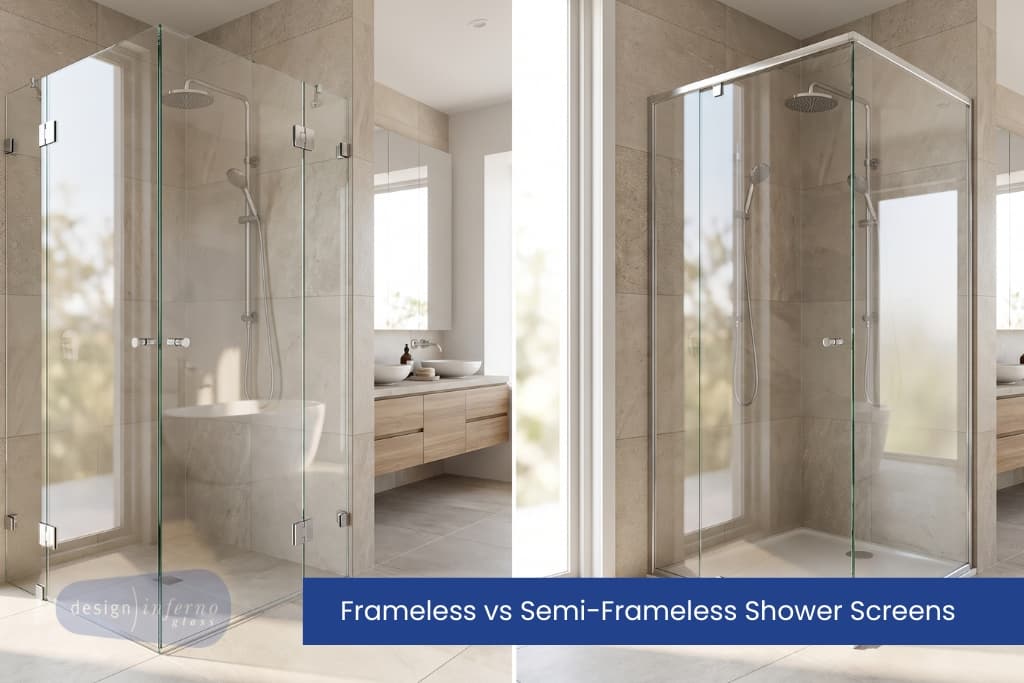
Quick answer: Frameless shower screens use thick 10mm-12mm toughened glass with no frame for a seamless, premium look, and they cost more ($900-$2,500+ installed). Semi-frameless screens use 8mm glass with slim edge framing, seal a little better on small showers, and cost less ($600-$1,400 installed). Choose frameless for a high-end open feel; choose semi-frameless for better value and easier fitting on uneven walls.
Key takeaways
- Frameless uses 10 mm-12 mm glass with no frame; semi-frameless uses 8mm glass with slim aluminium edges.
- Frameless costs more ($900-$2,500+ installed) than semi-frameless ($600-$1,400 installed).
- Both use toughened safety glass that must comply with AS/NZS 2208 and be installed to AS 1288.
- Frameless is easiest to clean and looks most premium; semi-frameless seals better on small showers and suits uneven walls.
- Choose frameless for a luxury open feel; choose semi-frameless for value and a more forgiving install.
What is the difference between frameless and semi-frameless shower screens?
The difference comes down to framing and glass thickness. A frameless screen has no metal frame at all, so the glass itself holds everything together. A semi-frameless screen keeps a slim aluminium frame on a few edges for support, while leaving the door and main viewing panel open. Both use toughened safety glass, and both give you a clean, modern look. The trade-offs sit in cost, sealing, and how much visible metal you are happy to have. Both sit within our wider glass shower screens range.
What is a frameless shower screen?
A frameless shower screen is a panel of thick toughened safety glass held by discreet hinges, clamps, or a slim wall channel. There is no perimeter frame. Because the glass carries the load, it needs to be 10mm or 12mm thick to stop it from flexing. The result is an almost uninterrupted sheet of glass that lets light flow through and makes a small bathroom feel bigger.
What is a semi-frameless shower screen?
A semi-frameless screen sits in the middle. It uses 8mm toughened glass with slim aluminium framing on some edges, such as the fixed panel or the outer border. The door usually swings free of a frame. You get a modern look and steady support, with a bit more help sealing water and coping with walls that are not perfectly square.

Frameless vs semi-frameless: a quick comparison
Here is how the two options stack up on the things most people ask about. Use it as a fast reference, then read the sections below for the detail behind each row.
| Feature | Frameless | Semi-frameless |
|---|---|---|
| Glass thickness | 10–12 mm toughened | 8 mm toughened |
| Framing | None (glass is the structure) | Slim aluminium on some edges |
| Look | Seamless, open, premium | Clean, modern, slightly framed |
| Typical cost installed | $900–$2,500+ | $600–$1,400 |
| Water sealing | Good; relies on precise fit | Slightly better on small showers |
| Cleaning | Easiest: fewer edges to trap grime | Easy; a few framed edges to wipe |
| Best for | Luxury builds, open feel | Renovations, value, tricky walls |
| Resale appeal | High | Solid |
Prices are typical supply-and-install ranges for a standard alcove or corner shower and vary by size, glass, hardware, and location.
How much do frameless and semi-frameless screens cost in Australia?
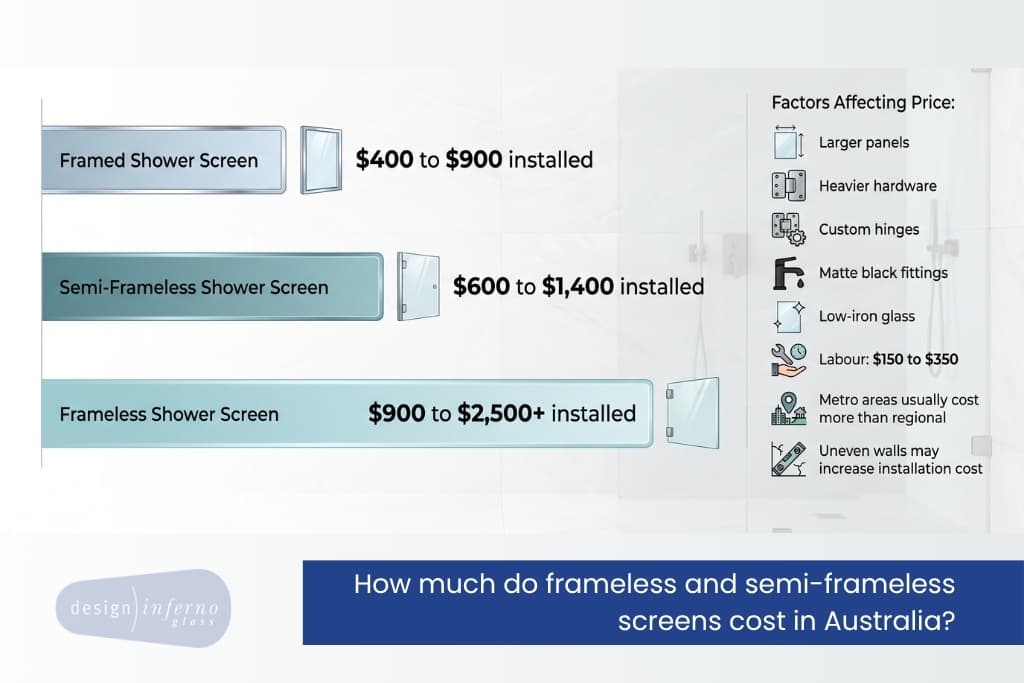
Frameless screens cost more because they use thicker glass and more precise fitting. As a rough guide, a frameless screen runs about $900 to $2,500 or more installed, while a semi-frameless screen sits around $600 to $1,400 installed. Framed screens are cheaper again, but they lose the open look. Walk-in and corner set-ups sit at the top of each range.1
Several things move the price. Larger panels need more glass and heavier hardware. Custom hinges, matte-black fittings, and low-iron (extra-clear) glass all add cost. Labour is usually $150 to $350, and metro rates tend to be higher than regional ones. If your walls are out of square, expect a little extra for packing and adjustment.
Which one looks better in your bathroom?
This is where frameless usually wins. With no metal around the edges, a frameless screen almost disappears, so your tiles, tapware, and niche do the talking. It suits open, high-end bathrooms and helps a compact ensuite feel light and roomy.
Semi-frameless still looks clean and current. The slim frame is visible, but many people like the crisp, defined edge it gives. If your style leans classic or you want the design to feel a touch more structured, semi-frameless is a smart pick that costs less.
Glass thickness and safety standards
Every shower screen sold in Australia must use Grade A safety glass. Toughened (tempered) glass is heated and rapidly cooled so it becomes four to five times stronger than ordinary glass, and it breaks into small, blunt pieces rather than sharp shards. Two standards apply: AS 1288 covers glass selection and installation, and AS/NZS 2208 covers the safety-glass testing. Each panel should carry a permanent stamp showing it meets AS/NZS 2208.2, 3
On thickness, 6mm is the legal minimum for partly framed and frameless toughened glass, but it is not the practical choice for a frameless screen. Because there is no frame to steady the panel, best practice is 10mm or 12mm for frameless and 8mm for semi-frameless. Thicker glass feels more solid, flexes less, and swings better on hinges.
Good to know: Always ask your installer to confirm the glass carries the AS/NZS 2208 stamp and that the job is fitted to AS 1288. It is your simplest check that the screen is compliant and safe.
Which is easier to clean and maintain?
Frameless screens are the easiest to keep clean. With almost no frame, there are fewer edges and channels for soap scum, mould, and grime to gather. Semi-frameless is still easy, but the framed edges and their seals need a wipe now and then.
Whichever you choose, a few simple habits keep the glass clear:
- Squeegee the glass after every shower to stop water spots and mineral marks.
- Wipe it clean weekly with a mild glass cleaner or a vinegar-and-water solution.
- Perform a monthly deep clean of the corners, hinges, and silicone seals.
- Consider applying a protective glass coating (such as EnduroShield or a nano coating) to repel water and soap, reducing cleaning time significantly.
Waterproofing and installation: what to watch for
Sealing is the one area where semi-frameless has a slight edge. The frame on the bottom and sides helps guide water back into the shower, which can matter in small or open showers. A frameless screen seals well too, but it leans on a precise fit and neat silicone work, so the quality of the install really counts.
A few practical points before you book a job:
- Check whether your walls are square. Uneven or twisted nib walls are easier to fit with a semi-frameless screen.
- Make sure the shower base or floor falls towards the drain so water does not pool at the glass.
- In coastal areas, ask for marine-grade hinges and fittings to resist salt-air corrosion.
- Use a licensed installer so the waterproofing and glass both meet Australian standards.
So, which should you choose?
Both are strong choices. Your decision usually comes down to budget, the look you want, and your bathroom itself. If neither is quite right, a fixed panel shower screen or a semi-framed shower screen may suit your space.
Choose frameless if you want:
- A seamless, high-end look with almost no visible metal.
- The easiest screen to clean and the strongest resale appeal.
- An open feel in a small bathroom, and you have the budget for it.
Choose semi-frameless if you want:
- A modern look at a friendlier price.
- Better sealing on a small or open shower.
- A more forgiving fit on walls that are not perfectly square.
Design Inferno tip: Not sure which suits your space? Book a free consultation and send us your bathroom measurements and a photo – we will recommend the right screen, glass thickness, and finish for your budget.
Frequently asked questions
Often, yes. You pay more up front, but you get a seamless premium look, the easiest cleaning, and strong resale appeal. If your budget is tight or your walls are uneven, a semi-frameless screen delivers most of the look for less.
Frameless screens need 10mm or 12mm toughened glass to stay rigid without a frame. Semi-frameless screens use 8mm. Six millimetres is the legal minimum for framed edges under AS 1288, but it is too thin for a quality frameless screen.
Not when they are fitted well. Frameless screens rely on a precise fit and quality silicone rather than a frame. On very small or open showers, a semi-frameless screen with a bottom rail can channel water back a little more easily.
Yes. Shower screens must use Grade A safety glass that meets AS/NZS 2208 and is installed to AS 1288. Look for the permanent safety stamp etched into each panel to confirm it complies.
Frameless, because it has the fewest edges and channels to trap soap scum and mould. Squeegee the glass after each shower, and an optional protective coating keeps either type clear with far less effort.
Yes, and it often works beautifully. The clear, uninterrupted glass makes a small bathroom feel larger and lets in more light, which is why frameless screens are popular in compact ensuites.
