
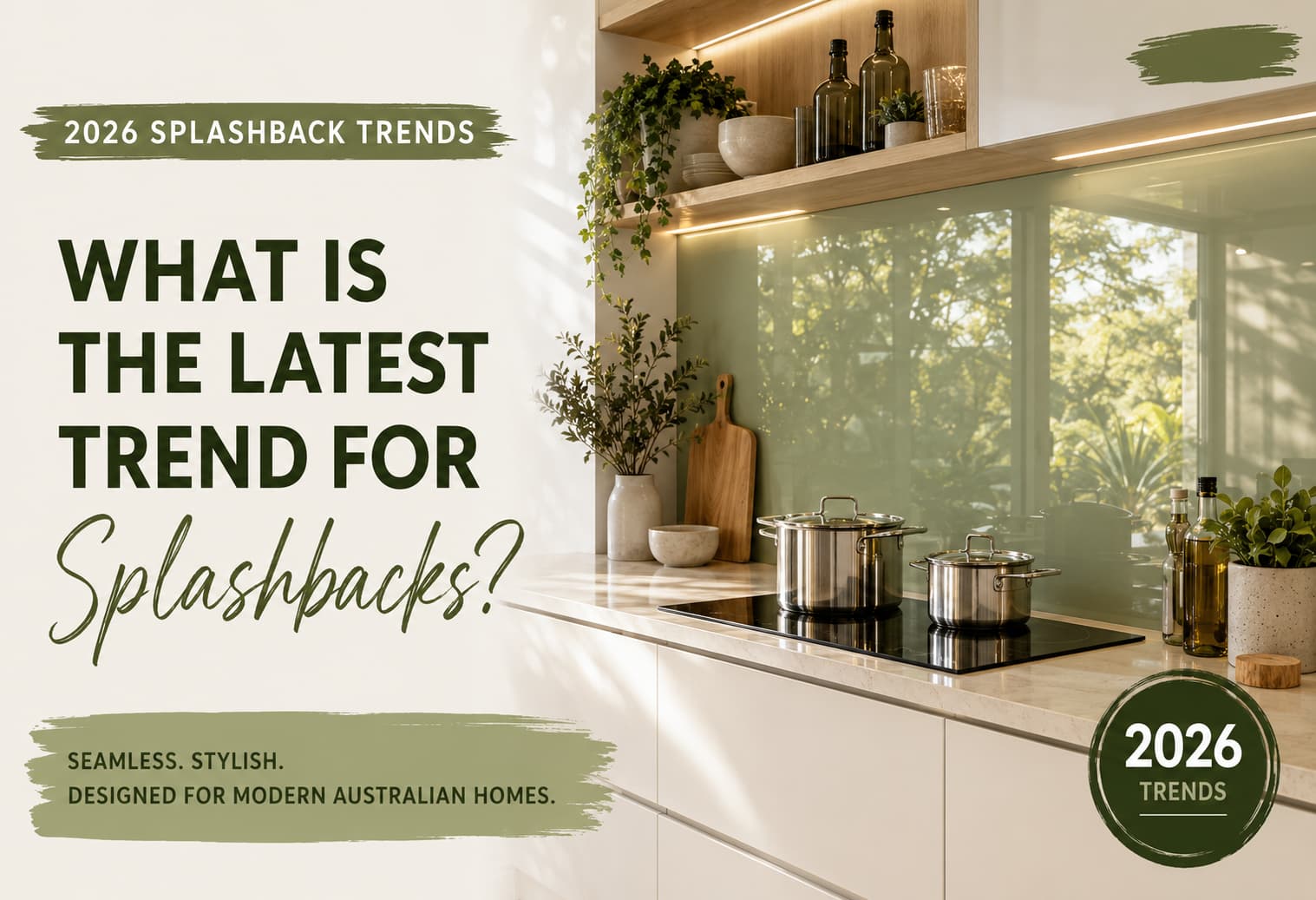
The glass splashback trends for 2026 are warm, grounded colours replacing cool grey, textured and fluted finishes, seamless full-wall panels, low sheen overtaking high gloss, lighting planned with the splashback, restrained stone and plaster prints, and low-iron glass as the default for warm colours. Custom colour matching runs through all seven.
The 7 glass splashback trends for 2026 at a glance
| # | Trend | What it looks like | Who it suits |
|---|---|---|---|
| 1 | Warm, grounded colours | Creams, clay, golden brown and muted green instead of cool grey | Almost any kitchen; safest long-term choice |
| 2 | Textured and fluted finishes | Soft vertical ridges that catch light, without deep grooves | Feature walls and calm neutral schemes |
| 3 | Seamless full-wall panels | One continuous panel, bench to ceiling, no joins or grout | Open-plan and busy family kitchens |
| 4 | Low sheen over high gloss | Satin finish that scatters light and hides fingerprints | Dark colours and high-traffic kitchens |
| 5 | Lighting planned with the glass | Under-cabinet LEDs chosen for colour temperature and position | Anyone choosing a textured finish |
| 6 | Restrained stone and plaster prints | Subtle travertine, plaster and zellige textures, not photo scenes | Kitchens wanting pattern without tiles |
| 7 | Low-iron glass as default | Ultra-clear glass with no green tint over warm colours | Cream, clay and mustard panels |
Key takeaways
Warm neutrals, clay tones and muted greens are replacing cool grey and stark white. The biggest visual shift is texture: it adds depth without pattern or grout.
- Seamless full-wall panels are in demand because there are no grout lines to clean.
- Low sheen is gaining on high gloss, mainly because it hides fingerprints.
- Lighting is now chosen alongside the splashback, not after it.
- Design Inferno splashbacks start from $850, with a two to four week lead time.
- Whatever the trend, glass behind a cooktop must be toughened Grade A safety glass.
Trend 1. Warm, grounded colours replace cool grey
The defining colour shift of 2026 is warm neutrals and nature-led tones taking over from cool grey and stark white. Kitchens are moving towards colours that feel calm and lived-in rather than clinical.
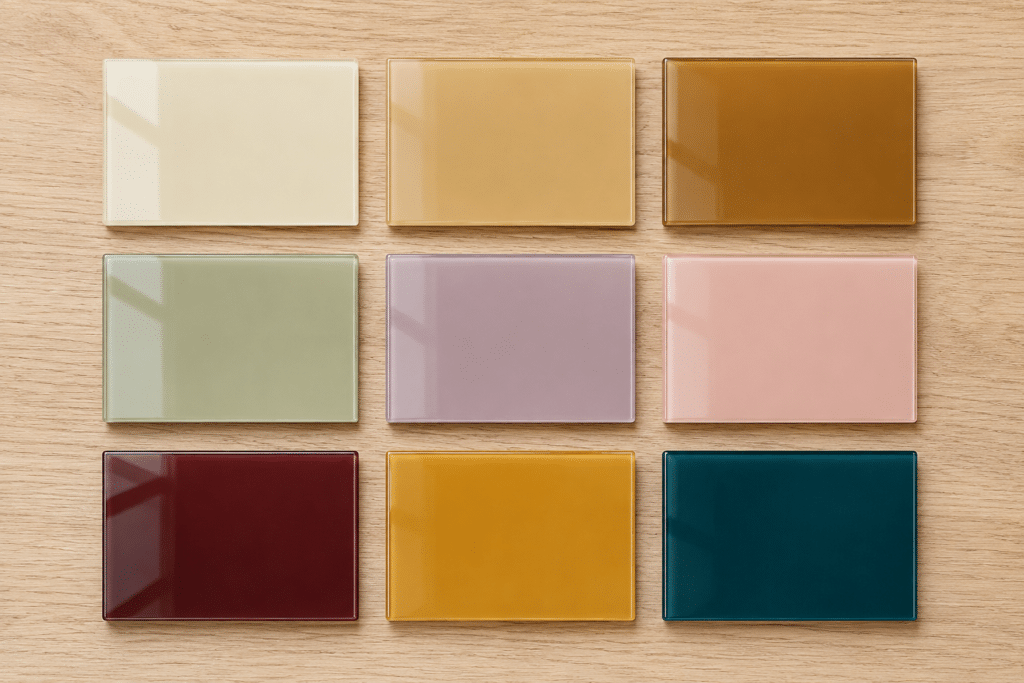
The Dulux Colour Forecast 2026 sets out three palettes, and each translates well onto glass. Elemental is the safest bet for most kitchens: warm whites and golden browns such as Blended Cream, Hog Bristle Quarter, Caramel Sundae and Coffee Dust. Ethereal is softer again, with gentle greens, mauves and blush tones like Tiamo, Soft Fresco and Different Pink. Evoke is the bold one, built on earthy pinks, warm mustards and dramatic accents such as Baked Clay, Germania, Misty Grape and Deep Aqua.
On glass, these colours behave differently to paint. A back-painted panel reads deeper and richer than the same colour on a wall, because you are looking through the glass at the colour behind it. Back-painted means the colour is applied to the rear face of clear glass. That extra depth is why muted, complex colours work so well this year, and why a small paint swatch can mislead you. Our colour simulator previews Dulux and 2CP colours on glass so you can shortlist before ordering samples.
| Dulux 2026 palette | Character on glass | Best used as |
|---|---|---|
| Elemental | Warm whites, golden browns, soft charcoal | Whole-wall panel, long-term neutral |
| Ethereal | Soft green, mauve, blush pastels | Light-filled kitchens, gentle feature |
| Evoke | Clay pink, mustard, berry, deep aqua | Single feature zone behind the cooktop |
Useful tip: if you have chosen a clay, cream or mustard tone, ask for low-iron glass. Standard glass carries a faint green tint that quietly cools any warm colour behind it.
Trend 2. Textured and fluted glass
Texture is the standout look of 2026 because it adds interest to a splashback without adding pattern or grout. After a decade of flat, glossy surfaces, people want depth they can see and feel.
Fluted glass has soft vertical ridges; reeded glass has finer, tighter lines. Both catch light down the wall and soften reflections, so the surface changes as you move around the room. On a splashback, the effect is subtle rather than showy, which is exactly why it suits everyday kitchens.
Textured painted glass is the practical route to this look. The texture sits in the finish rather than in deep grooves, so the front face stays smooth and easy to wipe down. That is the compromise most homeowners want: the tactile look of ridged glass, without ridges to trap cooking splatter behind the cooktop.
Trend 3. Seamless full-wall panels
Seamless panels are one of the strongest trends of 2026, driven by how much easier they are to keep clean. Instead of a narrow strip above the bench, more people are running one continuous panel from benchtop to overhead cabinets, or all the way to the ceiling.
The appeal is straightforward. There is no grout to discolour, no join for grease to sit in, and nothing to interrupt the colour across the wall. In open-plan homes, where the kitchen is visible from the living area, an unbroken surface makes the whole space read as calmer and larger.
Panels are also getting taller. Where a splashback used to stop at the rangehood, full-height panels behind a freestanding cooker or up a feature wall are now common. Design Inferno makes every panel to measure in our Keilor Park workshop, with cut-outs for power points and taps done before toughening, so the finished wall has no visible joins where it matters.
Worth knowing: glass cannot be cut, drilled or trimmed after it has been toughened. Every cut-out and edge is set at the design stage, which is why accurate measuring matters more on a seamless panel than a small one.
Trend 4. Low sheen overtakes high gloss
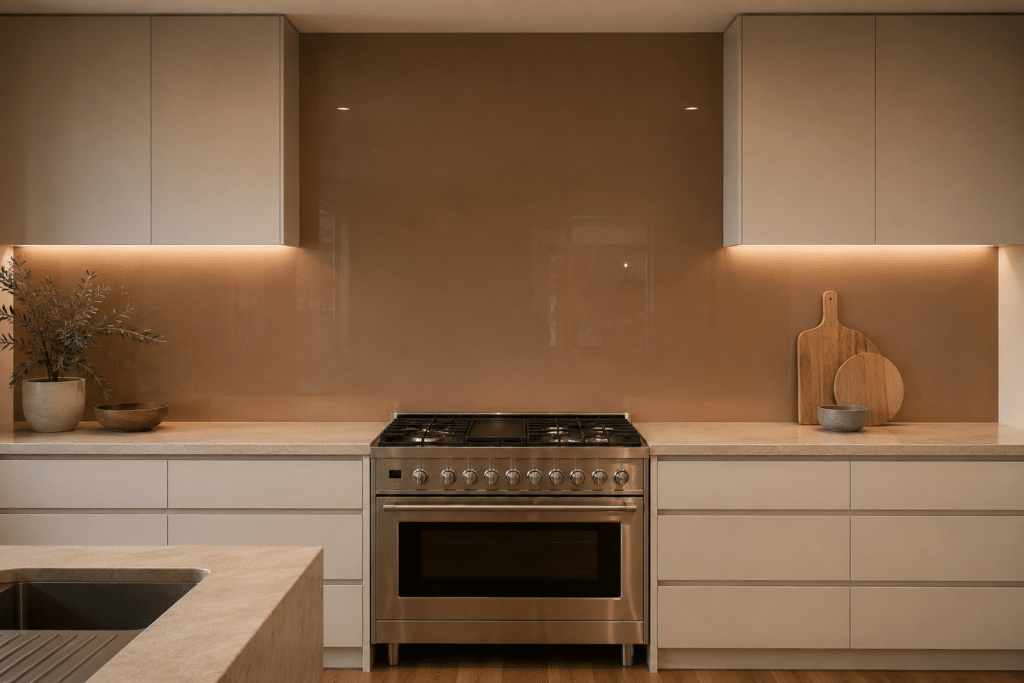
Gloss is still the most common finish, but low sheen is growing fastest because it hides fingerprints and softens reflections. This is the trend most driven by how kitchens actually get used.
High-gloss glass reflects the most light and makes colour look deepest, which is why it still suits small or dark kitchens. The trade-off is visible: it shows fingerprints, water spots and smudges, especially in dark colours. Low sheen and satin finishes scatter light instead of mirroring it, so marks are far less obvious day to day, and the colour reads softer.
Tinted mirror and hand-silvered finishes sit at the other end of the scale. They remain popular in compact kitchens and butler’s pantries, where bouncing light around does real work, and they pair well with the warm metallics trending in tapware.
| Finish | Look in 2026 | Best suited to |
|---|---|---|
| High gloss | Bright, deep colour, maximum reflection | Small or dark kitchens, pale colours |
| Low sheen/satin | Soft, contemporary, hides marks | Busy family kitchens, dark colours |
| Textured painted | Tactile, fluted-inspired depth | Feature walls, calm neutral schemes |
| Digitally printed | Stone, plaster or zellige look | Kitchens wanting pattern without tiles |
| Tinted mirror | Reflective, warm, space-expanding | Compact kitchens, butler’s pantries |
| Hand-silvered | Aged, artisan, one-off | Heritage homes, character renovations |
Trend 5. Lighting planned with the splashback
Lighting is now specified alongside the splashback rather than after it, because glass reflects whatever light hits it. Get this wrong, and a carefully chosen colour looks completely different once the kitchen is finished.
Under-cabinet LED strips are both the main risk and the main opportunity. Warm white LEDs at around 3000K push a colour towards yellow, which flatters clay, cream and mustard tones. Cool white LEDs at 4000K and above add a crisp, slightly blue cast that suits greys and greens but can drain warmth from a beige. Kelvin (K) is the scale used to describe how warm or cool a light source looks.
Placement matters as much as colour temperature. A strip mounted hard against the wall grazes the surface and exaggerates any texture, which looks superb on fluted glass and unforgiving on a flat gloss panel. Mounted further forward, the light washes evenly and colour stays true.
Recommendation: if you are choosing a textured finish this year, settle your lighting plan before you order the glass. Texture and grazing light are a package deal.
Trend 6. Restrained stone, plaster and zellige prints
Digitally printed splashbacks have moved from photographic scenes to quiet, material-led textures. The look people want in 2026 is stone, plaster and handmade tile, not a picture.
Digital printing puts an image on the rear of the glass before toughening, so it sits under a smooth, wipe-clean surface. The images being chosen now are subtle: travertine veining, lime plaster, raw linen, and the uneven glaze of zellige tile. You get the character of an artisan finish across a full panel, with one flat surface to clean and no grout.
The practical advantage over the real material is upkeep. Handmade zellige and honed travertine both need sealing and careful cleaning. A printed panel needs neither, and it will not stain behind a cooktop.
Trend 7. Low-iron glass becomes the default
Low-iron glass is becoming standard rather than an upgrade, because 2026’s warm palette shows up the green tint in ordinary glass. It is the least visible trend on this list and the one that most affects the finished colour.
Standard float glass contains iron, which gives it a faint green cast. You barely notice it on a white or grey panel. Put it over a cream, clay or soft mustard and it quietly cools the colour, so the finished splashback reads greyer than the sample you approved. Low-iron glass, sometimes sold as ultra-clear or Starphire, removes most of that tint.
The cost difference is modest against the cost of getting the colour wrong on a full wall. If your chosen colour sits anywhere in the warm half of the spectrum, specify it.
Recommendation: ask for your sample to be painted on the same glass type as the final panel. A colour approved on standard glass will not match a low-iron panel, and the reverse is worse.
Which splashback colours and looks are going out of style in 2026?
Cool blue-grey, stark white gloss, photographic prints and mosaic-look strips are the splashback looks fading fastest in 2026. None of them is wrong, but they read as belonging to the previous decade.
| Fading look | Why it is fading | What to choose instead |
|---|---|---|
| Cool blue-grey | Clashes with the warm timbers, brass and cream joinery in new builds | Warm greige or soft golden brown |
| Stark white high gloss | Reads cold against warmer cabinetry; shows every fingerprint | Warm white in low sheen |
| Photographic printed scenes | Dates quickly and competes with the rest of the room | Subtle stone or plaster print |
| Mosaic-look strips | Undercuts the clean, unbroken surface that makes glass worth it | Seamless single panel |
| Narrow bench-height strips | Leaves painted wall exposed to splatter above | Full-height panel |
Should you choose a trendy or timeless splashback?
Follow the trend on finish and texture, and stay closer to timeless on colour, because colour is the harder part to live with. A splashback is a medium-term decision, not a seasonal one.
Texture, sheen level and panel height are structural choices that age well, because they are about how the surface behaves rather than what is fashionable. Colour is where trends bite. A warm neutral from the Elemental palette will still look considered in ten years. A deep berry or bold mustard will not suit every future buyer, though it may be exactly right if this is your forever home.
| Your situation | Trend-forward choice | Safer choice |
|---|---|---|
| Renovating to sell within 2 years | Textured finish, neutral colour | Warm white or soft greige, low sheen |
| Forever home, confident taste | Deep berry, mustard or aqua panel | Feature colour behind cooktop only |
| Small or dark kitchen | Tinted mirror or gloss low-iron | Warm white gloss |
| Open-plan family kitchen | Full-height seamless panel, low sheen | Neutral seamless panel |
| Heritage or character home | Hand-silvered or fluted-look glass | Soft cream or sage, low sheen |
A useful middle path: choose a calm colour for the long run and let the texture do the talking. Our glass splashback guide sets out every finish we make, and the project gallery shows how each one reads at full size.
How much does a glass splashback cost in Melbourne in 2026?
Design Inferno glass splashbacks start from $850, with a lead time of two to four weeks from design approval. Price moves with size, finish and complexity rather than with how fashionable the colour is.
A flat painted panel in a single colour is the most economical option. Textured painted, digitally printed, tinted mirror and hand-silvered finishes sit above it, because each involves extra work before toughening. Cut-outs for power points, tap penetrations and awkward returns add to the cost, as does a full-height panel simply through the extra area of glass.
| What affects the price | Effect |
|---|---|
| Panel size | Largest single factor; full-height panels cost more through area alone |
| Finish | Flat painted is the base; textured, printed, mirror and hand-silvered sit above it |
| Glass type | Low-iron costs more than standard float glass |
| Cut-outs | Power points, taps and returns each add fabrication time |
| Access | Difficult stairs or tight corners can affect installation |
Getting a figure is quick:
- Send us your measurements or plans.
- Choose your colour and finish, using the colour simulator to shortlist.
- We return a free fixed price within one to two business days.
If you are still deciding, book a free consultation and we will bring samples to your kitchen so you can see them in your own light.
Do 2026 splashback trends still meet Australian safety standards?
Yes. Whatever colour or texture you choose, glass behind a cooktop must be toughened Grade A safety glass. Fashion does not change the requirement.
Under AS 1288:2021 and AS/NZS 2208, splashback glass in this position must be toughened, at least 5mm thick and permanently marked to show it complies. Toughened glass is heat-treated so it is several times stronger than ordinary glass, and if it does break it crumbles into small blunt pieces rather than long shards. The Housing Industry Association also recommends a minimum 200mm clearance between the cooktop and any combustible surface, so check your cooktop’s own installation instructions as well.
Two practical notes for the 2026 finishes. Textured painted and digitally printed panels are toughened the same way as flat ones, so texture does not reduce safety. And low-iron glass, used to keep warm colours true, is toughened to the same standard. Design Inferno splashbacks are safe behind all cooktops, including gas, and comply with Australian safety standards.
Tip: ask your installer to show you the compliance stamp in the corner of the glass. It is small, permanent and the simplest proof that the panel meets AS/NZS 2208.
Frequently asked questions
Warm neutrals lead, particularly creams, warm whites and soft golden browns. Muted greens and clay pinks are the fastest-growing feature colours, while cool blue-grey is fading.
Yes. Glass remains a mainstay because it is grout-free, wipe-clean and available in any custom colour, which lets it carry each year’s palette without changing the material itself.
Textured painted glass is not, because the texture sits in the finish and the front face stays smooth. Deeply grooved glass is harder to wipe, which is why we do not recommend it directly behind a cooktop.
Both have vertical lines. Fluted glass has wider, softer ridges; reeded glass has finer, tighter lines. Fluted reads as the calmer of the two across a large splashback.
Yes. Clear or low-iron glass can be back-painted to almost any paint code, including the Dulux Colour Forecast 2026 palettes. Ask for a painted sample on the same glass type as the final panel, because colour reads deeper through glass.
Design Inferno splashbacks start from $850. The final price depends on size, finish, glass type and cut-outs, and we return a free fixed quote within one to two business days.
Two to four weeks from design approval, allowing for colour matching, toughening and installation. Complex shapes or printed panels sit at the longer end.
It can. Bold colours suit homes you plan to keep for years. If you may sell within a couple of years, choose a warm neutral panel and add trend through tapware, stools and accessories instead.
Yes. All these panels are toughened to AS/NZS 2208 and comply with AS 1288:2021, so texture and print make no difference to the safety rating.
