
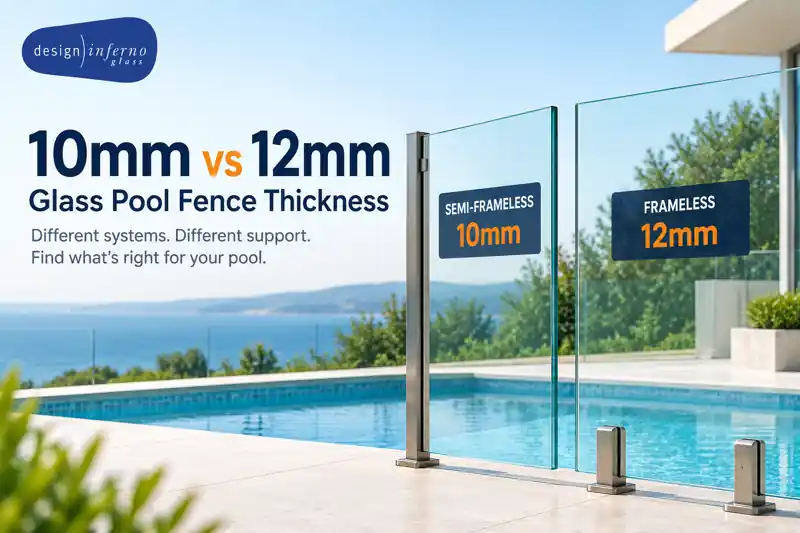
Frameless glass pool fence panels are typically 12mm toughened safety glass. Semi-frameless panels are typically 10mm. Neither figure is set by an Australian standard. The thickness follows from how the panel is held, because a frameless panel is supported along its bottom edge only and has to carry load across its full height.
Key takeaways
- No Australian standard names a pool fence glass thickness. AS 1926.1 governs the barrier, not the glass.
- AS 1926.1 states that glass used in barriers must comply with AS 1288, which derives thickness from the panel.
- 12mm frameless and 10mm semi-frameless are industry conventions, not legal minimums.
- Frameless panels are held on one edge only, so they need more thickness to resist the same load.
- Panel width matters as much as height. A wider panel flexes more and pushes the thickness up.
- Thicker glass tolerates impact and severe weather better, and weighs materially more per panel.
- Two quotes with different thicknesses usually describe two different fixing systems, not one cheaper supplier.
Pool fence glass at a glance
The figures below separate what is actually regulated from what is convention. The barrier dimensions come from AS 1926.1. The glass specification comes from AS 1288 and AS/NZS 2208. The thicknesses are what the industry builds to, not what the law requires.
| Attribute | Specification | Source |
|---|---|---|
| Glass type | Grade A toughened safety glass | AS 1288, AS/NZS 2208 |
| Frameless thickness | 12mm typical | Industry convention |
| Semi-frameless thickness | 10mm typical | Industry convention |
| Thickness mandated by standard | None. AS 1926.1 refers glazing to AS 1288 | AS 1926.1-2012 |
| Minimum barrier height | 1200mm on the outside of the barrier | AS 1926.1-2012 |
| Maximum gap under the barrier | 100mm | AS 1926.1-2012 |
| Maximum opening between vertical members | 100mm | AS 1926.1-2012 |
| Non-climbable zone | Arc of not less than 900mm | AS 1926.1-2012 |
| Fixing systems | Spigots or mini posts, base channel, slim posts, side-fixed brackets | Design dependent |
| Hardware | 316 grade stainless steel, chemical anchors where required | Fabrication standard |
| Gate hardware | Self-closing hinges and a self-latching latch, gate swings away from the pool | AS 1926.1-2012 |
| Edgework | Polished and arrised on all exposed edges | Fabrication standard |
| Processing limit | Cannot be cut or drilled after toughening | Fabrication constraint |
| Sign-off | Registered pool safety inspector, plus council registration in Victoria | Building Regulations 2018 (Vic) |
Does any Australian standard require 10mm or 12mm glass?
No. AS 1926.1-2012 sets the barrier requirements and does not nominate a glass thickness anywhere.
What the standard does say is that glass used in barriers must comply with AS 1288. That is the glass selection and installation standard. It derives a thickness from the panel in front of it, rather than publishing one figure for every pool fence.
This is why suppliers quote different numbers in good faith. Search the question, and you will find 8mm, 10mm and 12mm all presented as the answer. None is wrong as a general statement. The correct thickness depends on the panel size and how it is held.
WHAT THE STANDARDS ACTUALLY DO
AS 1926.1-2012 governs the barrier: height, gaps, non-climbable zones and gates. AS 1288 governs the glass: thickness follows from panel height, width and edge support. AS/NZS 2208 governs the material: the safety glazing the panel is manufactured to. Victoria adds registration and inspection through the Victorian Building Authority framework, not a different thickness.
What is the difference between 10mm and 12mm pool fence glass?
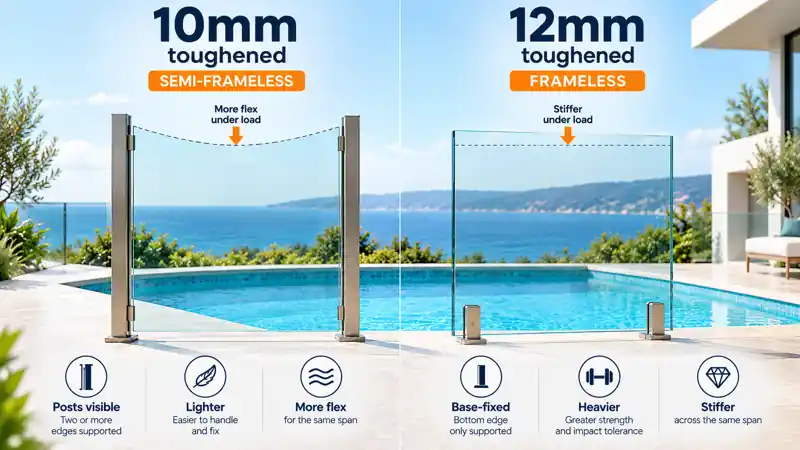
Two millimetres of glass changes how much the panel flexes, how well it takes an impact, how much it weighs and what hardware it needs.
| Factor | 10mm toughened | 12mm toughened |
|---|---|---|
| Typical use | Semi-frameless panels held between posts | Frameless panels held at the base only |
| Edge support | Two or more edges supported | Bottom edge only |
| Deflection under load | Flexes more for the same unsupported span | Stiffer across the same span |
| Impact tolerance | Adequate when the span is supported | More tolerant of impact and severe weather |
| Panel weight | Lighter, easier to handle and fix | Materially heavier per panel |
| Hardware demand | Lighter duty, posts share the load | Heavier duty spigots and deeper fixings |
| Maximum practical panel width | Narrower before deflection becomes an issue | Wider panels achievable |
| Relative cost | Lower glass cost and lower hardware cost | Higher on both |
| Look | Posts visible between panels | Uninterrupted glass line |
Neither is the better glass in the abstract. A 10mm panel in a properly posted semi-frameless run is doing an easier job than a 12mm panel standing on two spigots.
Why is frameless glass thicker than semi-frameless?
Because a frameless panel is a cantilever. It is held along the bottom edge only, so it resists load across its full height with no help from the sides or top.
Picture a 1200mm panel standing in two spigots. Push near the top, and the glass carries that point load down to the base fixings. Nothing supports the free edges. The further the load sits from the support, the more the panel flexes.
Add a post on each side and the same panel is supported on three edges. The span between supports shortens and deflection drops. The glass can be thinner while doing the same job. The fixing system chooses the thickness, not the other way round.
THE ONE THING TO REMEMBER
Thickness is an output, not an input. Decide how the fence will be held and what the panels will measure, and the glass specification follows from that.
Does panel width change the thickness needed?
Yes, and it is underrated. Height is fixed by the 1200mm barrier minimum, so width is the dimension that varies. A wider panel has a longer unsupported span between its base fixings. That increases deflection under the same load.
This is why a run of narrow panels can sometimes use thinner glass than a run of wide ones in the same backyard. It is also why panel layout is settled at the measure rather than assumed from the fence length.
Is 10mm glass safe for a pool fence?
In the right configuration, yes. A 10mm panel supported between posts can comply fully and last for decades. The question is never the number on its own. It is whether that thickness suits the panel size and the fixing system it sits in.
Where 10mm becomes a concern is a frameless run with wide panels, carrying everything from the base. Thinner glass there flexes more and is less forgiving of a hard impact or a severe storm. A compliant barrier and a robust one are not always the same thing.
How does the fixing system decide the thickness?
Spigots, channels, posts and brackets each support a different number of edges, which is what sets the glass specification.
| Fixing system | How it holds the panel | Typical glass | Suits |
|---|---|---|---|
| Spigots or mini posts | Clamps the base at two or more points, core drilled into concrete or chemically anchored, or bolted to a deck | 12mm | Level concrete, pavers over a slab, structural timber decking |
| Base channel | Supports the entire bottom edge in a continuous channel | 12mm | New landscaping where the channel is set before paving |
| Slim posts (semi-frameless) | Holds panels between vertical posts, supporting the side edges | 10mm | Long runs, sloping ground, tighter budgets |
| Aluminium frame (framed) | Frames all four edges, so the frame carries the load | Thinner than frameless | Uneven ground, lowest cost |
| Side-fixed brackets | Fixes the panel to the face of a slab or wall | Design dependent | Raised edges, retaining walls, decks |
A base channel supports the whole bottom edge, while spigots support it at points. Both are frameless systems using 12mm glass. They distribute load differently, which is why panel layout is engineered rather than estimated.
The three styles are compared in detail, including cost and appearance, in our guide to frameless, semi-frameless and framed glass pool fencing.
What glass type must a pool fence use?
Grade A toughened safety glass, selected and installed under AS 1288 and manufactured to AS/NZS 2208.
Toughened glass is heat treated so that it breaks into small blunt fragments rather than long shards. That behaviour is why every swimming pool glass fence uses it. People around a pool are barefoot, and often they are children.
Toughening happens before the panel leaves the factory, and it is irreversible. A toughened panel cannot be cut, drilled or trimmed afterwards. Every dimension and every spigot cutout is settled before the glass is processed. Low-iron glass is available where a client wants the green tint of standard glass removed from the panel edge.
Heat soaking and why fabricators mention it
Toughened glass carries a very small risk of spontaneous failure from a nickel sulphide inclusion. That is a tiny impurity trapped during manufacture, which can expand years later. Heat soaking is an extra oven cycle that forces most affected panels to fail in the factory rather than in a backyard.
Ask whether panels are heat soaked, particularly on long frameless runs. Replacing one panel later means matching an existing layout.
Two quotes, two thicknesses: which one is right?
Compare the fixing systems before comparing the glass. A thinner panel in one quote usually means a different system, not a cheaper version of the same fence.
A 10mm quote and a 12mm quote for the same backyard often describe semi-frameless and frameless, respectively. That is a different fence, with a different look, different hardware, different ground preparation and a different price. Comparing them on thickness alone misses what actually changed.
Ask each supplier the same four questions and the quotes become comparable.
- What is the fixing system? Spigots, base channel, slim posts or a frame. This decides the thickness.
- What are the panel sizes? Width matters as much as height, because it sets the unsupported span.
- Is the glass Grade A toughened, and is it heat-soaked? Both should be stated, not assumed.
- What is fixed into, and what preparation is included? Concrete, pavers, decking or soft ground change the method and the cost.
TREAT THESE AS WARNING SIGNS
- A thickness quoted before anyone has measured the site or set the panel layout.
- A supplier who cannot name the standard the glass is selected under.
- Frameless pricing with no detail on what the spigots fix into.
- No mention of who provides compliance documentation for the inspection.
Does thicker glass cost more?
Yes, in two places. The glass itself costs more per square metre, and the heavier panel needs heavier hardware and deeper fixings.
The gap between a 10mm and a 12mm fence is rarely just the glass. Frameless systems also need a solid, level base. Preparing one can be a bigger line item than the panels.
Current pricing and what drives it is set out on the glass pool fencing page, and every job is quoted after a measure rather than per metre.
How are custom pool fence panels measured and made?
A glazier measures the site, the panel layout and fixing system are set, then the glass is cut, processed and toughened to those exact sizes.
Toughened glass cannot be altered afterwards, so the measure decides everything. The sequence runs as follows.
- Enquiry and quote. Supply the fence line, photos or a site plan. Design Inferno measures and quotes free of charge.
- Check measure. Panel sizes, gate position, ground levels and the substrate are confirmed on site.
- System and specification. Frameless, semi-frameless or framed: the fixing system and the glass thickness that follows from both.
- Manufacture. Panels are cut to size, edges are polished and arrised, cutouts are made, then the glass is toughened at the Keilor Park factory.
- Installation. Spigots or channels are set into the substrate, panels are installed and levelled, and gate hardware is adjusted so it latches every time.
- Inspection. A registered pool safety inspector assesses the barrier and issues the compliance certificate.
ORGANISE THESE EARLY
- The substrate, because pavers on sand need footings before any glass goes in.
- Gate position and swing direction, since a pool gate must be self-closing, self-latching and swing away from the pool.
- Final ground levels, because they set the gap under the barrier.
- Council registration, which is separate from the barrier itself.
Where can you get custom glass pool fence panels made in Melbourne?
Design Inferno manufactures custom glass pool fence panels at its Keilor Park factory and installs them across Melbourne.
The factory and showroom are at 48 Logistics Street, Keilor Park. Suburbs served include Point Cook, Caroline Springs, Doncaster, Kew, Hawthorn, Williamstown, Brunswick and Essendon.
Panels are cut and toughened in-house rather than resold. The specification can therefore follow the site instead of a stock size. Completed pool fencing is shown in the project gallery. The same factory makes glass balustrades, which are a different barrier under different rules, so a pool fence is never specified from balustrade figures.
The next step
Thickness is the last decision, not the first. Once the fixing system and panel layout are settled, the glass specification follows from them. A quote naming a thickness before anyone has seen the site is working backwards. What matters is the substrate, the panel sizes, and whether the fence is frameless or posted.
Specification starts with a site visit. Book a free measure and quote, and the panel layout, fixing system and glass specification are set together.
Frequently asked questions
A gate panel usually matches the run it sits in, so 12mm on a frameless fence and 10mm on a semi-frameless one. The hinges and latch are rated for the panel weight, which is one reason the gate is specified with the fence rather than added later.
No. Toughened glass cannot be cut, drilled or trimmed after it is processed, because the surface tension that makes it safe is also what makes it shatter when cut. Every panel is made to the measured size, which is why the check measure happens before manufacture.
It can. Exposed and coastal sites carry higher wind loads on the barrier, and salt exposure also affects the hardware specification. Both are assessed at the site level rather than assumed from the postcode.
In Victoria, the pool or spa must be registered with the council, and the barrier must be inspected by a registered pool safety inspector or building surveyor who issues a compliance certificate. A new certificate is required every four years.
No. A pool barrier is governed by AS 1926.1, and a balustrade by the National Construction Code, and the heights and gap rules differ. The glass for both is selected under AS 1288, but a pool fence should never be specified from balustrade figures.
Manufacturing time depends on the panel count, any shaped panels and the current factory schedule. Design Inferno provides a timeline with the quote, and most residential fences are installed in one to two days once the glass is ready.
