
A pool fence and a glass balustrade can look identical, but they do different jobs under different rules. A balustrade stops people falling from a height of 1 m or more. A pool fence stops young children from reaching the water. In Victoria, that difference changes the height, the gaps, the gates, the glass design and whether the barrier must be registered and inspected every four years. Choosing the wrong one usually means failing inspection and replacing glass.
Key takeaways
- The purpose of the barrier decides the rules, not the material or how it looks.
- Pool barriers need at least 1200 mm of height, self-closing and self-latching gates, and clear climbing zones. Balustrades on a balcony need at least 1000 mm.
- A pool barrier must be registered with council and certified every four years. A balustrade has no registration cycle.
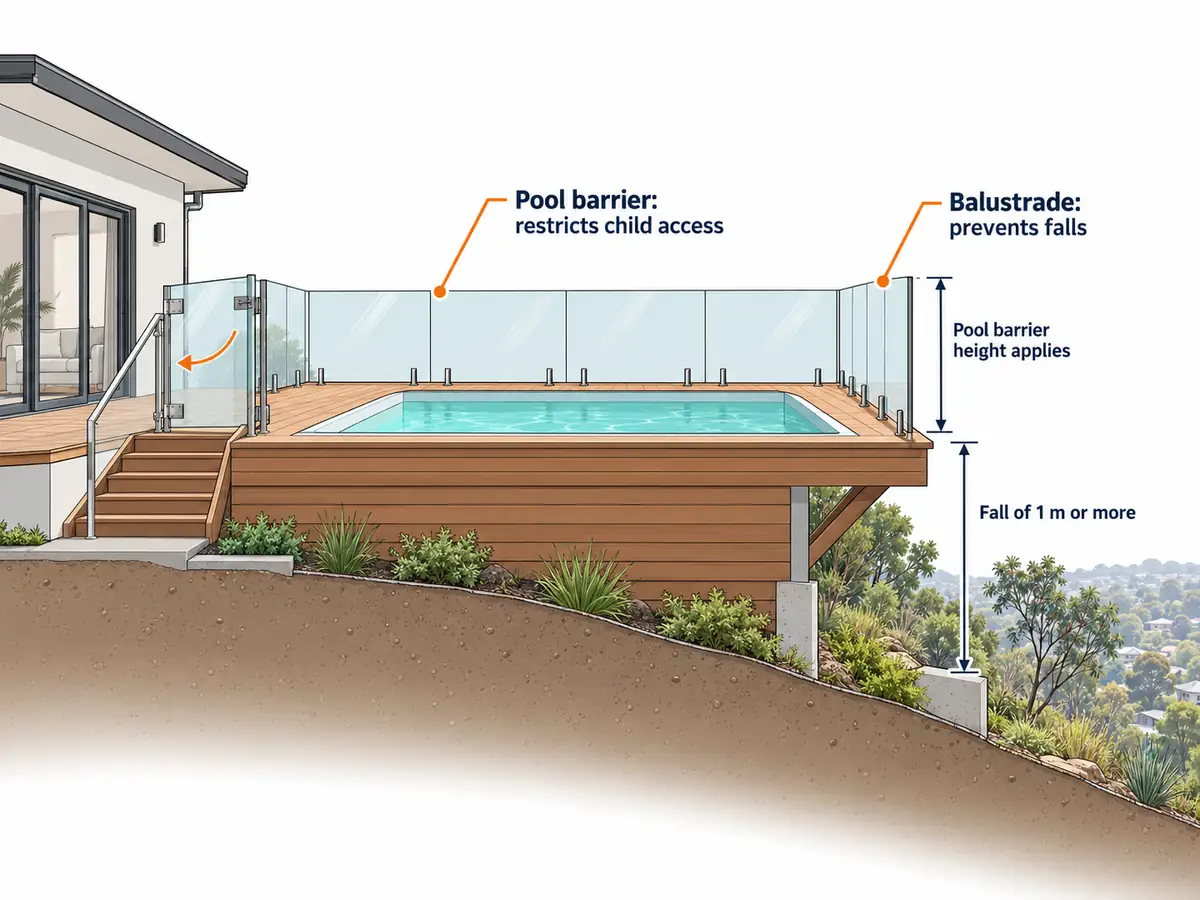
- A barrier on a raised pool deck often has to meet both sets of rules at once.
- Your building surveyor confirms what applies to your project before any glass is made.
The short answer: different jobs, different rules
A glass balustrade is a fall barrier. Under the National Construction Code, one is required along a balcony, deck, stair or landing wherever someone could fall 1 m or more to the surface below. Its job is to stop adults and children from going over or through it, and to hold the load of people leaning on it.
A glass pool fence, called a pool safety barrier in the regulations, is an access barrier. In Victoria, every pool or spa that can hold more than 30 cm of water needs one, whether or not children live at the property. Its job is to stop children under five getting into the pool area without an adult.
Design Inferno makes both glass balustrades and glass pool fences, and the two are specified differently from the first measure. For a plain-English explanation of the term itself, see what a balustrade is.
Side by side: the differences that matter
The figures below are the common requirements for new work in Victoria. An existing pool is assessed against the standard that applied when its barrier was approved, so check your council’s records.
| Feature | Glass balustrade | Glass pool fence |
|---|---|---|
| Main purpose | Stop falls | Stop young children reaching water |
| When it is required | A fall of 1 m or more is possible | Pool or spa can hold more than 30 cm of water |
| Main rules | National Construction Code barrier provisions and AS 1288 | AS 1926.1-2012 and the Building Regulations 2018 |
| Minimum height | 1000 mm above the floor, 865 mm above stair nosings | 1200 mm above finished ground level |
| Openings | No opening a 125 mm sphere can pass through | No more than 100 mm under the barrier |
| Climbing rules | Horizontal elements between 150 mm and 760 mm must not help climbing, where the fall exceeds 4 m | 900 mm non-climbable zone measured down from the top on the outside, plus 300 mm clear space inside |
| Gates | Not part of the rules | Self-closing, self-latching, swinging away from the pool |
| Registration | None | Registered with your local council |
| Ongoing inspection | Owner checks (a yearly visual check is recommended) | Certified by a registered inspector every four years |
Sources: NCC barrier and handrail provisions, BPC balcony and balustrade guide, BPC pool barrier checklist for pools from 1 May 2010.
For how balustrade heights are measured on stairs and finished floors, read how high a glass balustrade needs to be.
Why the purpose changes everything
The two rule sets protect against different accidents, so they solve different problems.
A balustrade is designed for falls. It has to resist the force of people leaning, crowding or stumbling against it, so the glass and fixings are engineered for structural loads under AS/NZS 1170. Its height targets an adult’s centre of gravity, and the climbing rule only applies to very high drops.
A pool fence is designed around a toddler. The extra height, the clear zones on both sides and the self-closing gate all aim to stop a small child climbing over, squeezing under or walking through. The fence must also be rigid enough to resist an adult pushing on it, but the critical figures are about a child’s reach and footholds.
IMPORTANT TO KNOW A
pool fence is a back-up to supervision, not a replacement for it. A compliant barrier slows a child down. It does not make a pool safe on its own.
Can one be used as the other?
Usually not, and this is the most common mistake on this topic.
| A balustrade used as a pool fence | Pool fencing used as a balcony balustrade |
|---|---|
| Generally fails on height, because 1000 mm is below the 1200 mm pool minimum. It may also lack a compliant gate, have footholds in the climbing zone or leave too large a gap at the base. | Fails for a different reason. It may meet the height, but pool fence panels and fixings are not automatically designed for the loads a fall barrier must carry. A balustrade’s glass, spigot spacing and handrail decision are engineered for the specific span and drop. A pool fence panel bought off the shelf is not. |
PRACTICAL TIP
Tell your glazier what the barrier is protecting against before they measure. “It’s glass around the pool” and “it’s glass on the edge of a 2 m deck” lead to different designs, even when they look the same.
When one barrier has to do both jobs
Some Melbourne backyards need a single barrier that is both a balustrade and a pool fence. In these cases it must meet both rule sets at the same time, and the stricter figure usually wins.
| Layout | What usually applies | What to confirm with your surveyor |
|---|---|---|
| Raised pool deck with a drop of 1 m or more on the outside | Pool barrier rules and balustrade rules on the same panels | Height, loads, and how the climbing zone works on the drop side |
| Ground-level pool, flat yard | Pool barrier rules only | Gate position, clear zones, boundary fence height |
| Balcony or upper deck that looks over the pool area | Balustrade rules on the balcony. The pool area still needs its own barrier | That the balcony does not create a path into the pool area |
| Terraced garden with the pool on a retaining wall | Pool barrier rules, with special rules where retaining walls form part of the barrier. Balustrade rules where the fall is 1 m or more | Retaining wall heights and slopes |
| Boundary fence forming part of the pool barrier | Pool barrier rules, with a higher minimum for boundary fences | Height and clear zone at the top of the fence |
A raised pool deck is the classic example. The glass at its edge has to keep a toddler out of the pool area and stop anyone falling off the deck. That means pool barrier height, gaps and gate rules, combined with balustrade-grade engineering for the loads.
Gates, climbing zones and the details people miss
Most pool fence failures come from small details around the glass, not the glass itself. These details have no equivalent on a balustrade.
| Detail | What the rules expect |
|---|---|
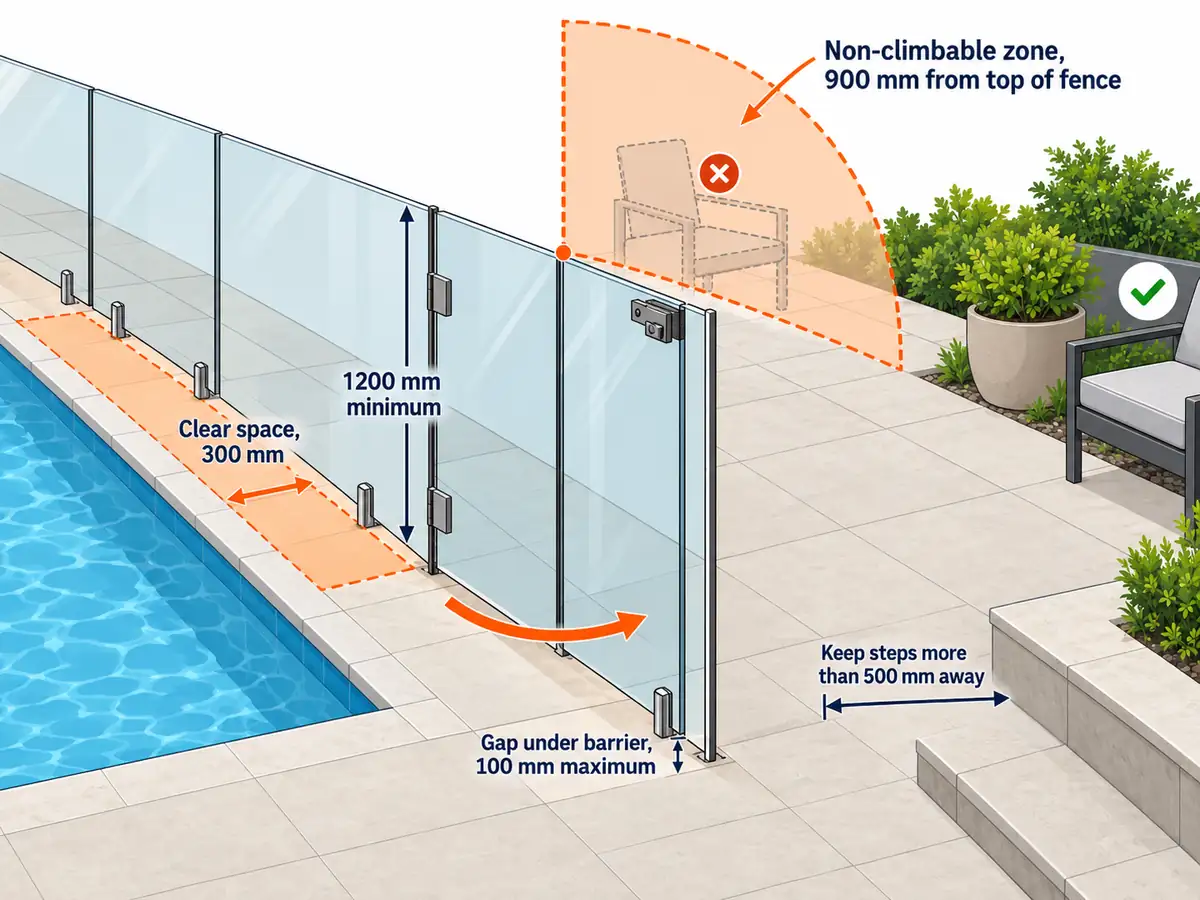
| Gates | Swing outward, away from the pool. Close and latch on their own from any open position. |
| Latches | Release at least 1500 mm above the ground, or shielded so a child outside the fence cannot reach the release. |
| Hinges | Hinges on glass gates can create footholds. The checklist asks whether pivot-style hinges could help a child climb. |
| Non-climbable zones | A 900 mm zone, measured down and out from the top of the fence, kept free of footholds and climbable objects. Inside, a 300 mm clear space is required. |
| Changes of level | Steps or garden edges should be kept more than 500 mm from the barrier, so they do not reduce its effective height. |
| Boundary fences | Where they form part of the pool barrier: minimum height of 1800 mm, with a 900 mm non-climbable zone at the top on the pool side for barriers approved from 1 May 2013. |
| Access from the house | A new outdoor pool area must not be directly accessible through a door from a building. |
Registration, inspection and who signs off
This is the difference most comparisons leave out. A balustrade is signed off once. A pool barrier carries an ongoing legal obligation.
For a pool or spa in Victoria, the owner must:
- Register the pool or spa with the local council.
- Have the barrier inspected by a registered pool inspector, building inspector or building surveyor.
- Lodge the certificate of barrier compliance with council within 30 days of the date it is issued.
- Repeat the inspection and certification every four years.
The owner must also keep the barrier working at all times, and gates must stay closed except when someone is entering or leaving. Not lodging a certificate is an offence and can lead to an on-the-spot fine. See the Building and Plumbing Commission’s pool and spa requirements for the full rules.
A balustrade is approved by the building surveyor when the work is completed. After that, the owner is responsible for keeping it safe. The Building and Plumbing Commission recommends a visual check of balconies and balustrades each year, including fixings and any cracked glass, which should be replaced immediately.
Does the glass differ?
Both barriers use Grade A safety glass selected under AS 1288, so the starting material is similar. The difference is in how the glass is designed.
Balustrade glass is engineered for the span between fixings, the barrier height, the drop and whether a handrail links the panels. Removing a handrail can change the glass type the standard requires. Design Inferno manufactures its balustrades from toughened laminated safety glass and lists AS 1288 and AS/NZS 2208 on its product page.
Pool fence glass is designed around panel width, the fixing system and gate hardware. Design Inferno’s pool fences are made to measure in frameless and framed designs, using mini post, channel fix and framed systems.
Thickness is decided per project, not from a web page. Read how thick pool fence glass should be and the difference between toughened and laminated glass for details.
Cost and maintenance differences
At the time of writing (October 2026), Design Inferno lists glass pool fences from $1,500 and glass balustrades from $2,000. These are starting points only. Every job is quoted after measuring, and prices change.
| Barrier | Main cost drivers |
|---|---|
| Pool fences | Total run length, number of gates and their hardware, fixing system, ground conditions and any boundary fence work |
| Balustrades | Drop height, span and fixing method, handrail choice, stairs and landings, the substrate the fixings go into, and engineering |
| Dual-purpose barriers | Usually cost more than either alone, because they need pool barrier heights and gates with balustrade-grade engineering |
Maintenance follows the purpose. Pool fence owners should test the gate every time it is used: it should swing shut and latch from any position. Keep pot plants, furniture and pool toys out of the clear zones. Balustrade owners should watch for loose fixings, movement in the panels and corrosion on spigots, especially near the coast.
Getting it right on your project
Before you request a quote, work through this short checklist.
QUICK CHECKLIST
- Is there a pool or spa that can hold more than 30 cm of water? If yes, a pool barrier is required.
- Is there a drop of 1 m or more anywhere along the barrier line? If yes, balustrade rules apply there too.
- Where will the gate go, and does it swing away from the pool?
- Are there steps, garden beds, retaining walls or a boundary fence near the barrier line?
- Has your building surveyor confirmed which rules apply, including for an existing pool’s approval date?
- Is the finished floor or paving level known before the check measure?
COMMON MISTAKE
Measuring for a pool fence before the paving or decking is finished. Toughened glass cannot be cut after manufacture, so a barrier that ends up too low has to be remade.
Conclusion
A glass balustrade and a glass pool fence share a material, not a purpose. A balustrade stops falls and is engineered for loads. A pool fence keeps young children out of the pool area, needs taller panels, compliant gates and clear zones, and must be registered and certified every four years. When one barrier does both jobs, it must meet both rule sets.
The safest path is to describe the barrier’s purpose clearly, confirm the rules with your building surveyor and have the glass designed for that job. Design Inferno manufactures both pool fences and balustrades at its Keilor Park factory. Request a free quote to discuss your pool area, deck or balcony.
Frequently asked questions
A balustrade prevents falls where the drop is 1 m or more. A pool fence restricts young children’s access to a pool or spa. That different purpose means different heights, gap rules, gate requirements and inspection obligations.
At least 1200 mm above finished ground level for a barrier built to AS 1926.1-2012. Boundary fences that form part of the barrier need to be at least 1800 mm. Older pools are assessed against the standard that applied when their barrier was approved.
The balcony needs a balustrade if the drop is 1 m or more. The pool area still needs its own compliant barrier. Your surveyor will check that the balcony does not give children a way into the pool area.
You register the pool or spa, not the fence. In Victoria, owners must register it with council and lodge a certificate of barrier compliance, then have the barrier inspected and certified every four years.
Both use Grade A safety glass under AS 1288, but the panel design is different. Balustrade glass is engineered for fall loads, spans and handrails. Pool fence glass is designed around gates, posts and panel widths. Your glazier specifies each for the job.
A compliant glass pool fence restricts access, but no barrier replaces adult supervision. Keep the gate closed, test that it self-closes and latches, and keep climbable objects out of the clear zones.
