
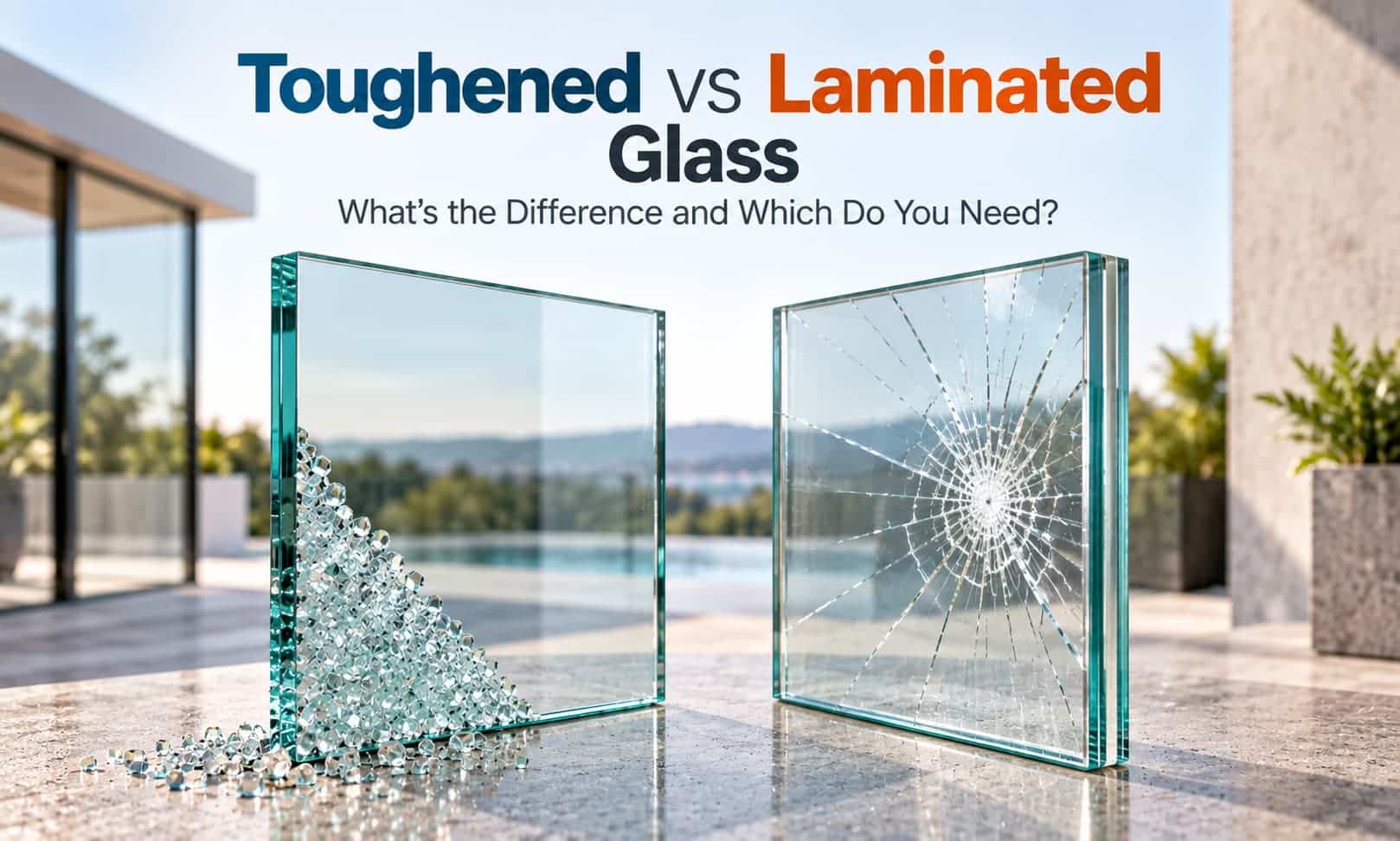
Toughened and laminated glass are the two main types of safety glass. Toughened glass is heat-treated to be about four to five times stronger than ordinary glass, and it breaks into small, blunt granules. Laminated glass has a plastic interlayer that holds the pieces together when it breaks. Choose toughened for shower screens, splashbacks and pool fences; choose laminated for overhead glass, security and noise reduction.
Key takeaways
- Toughened glass is about 4–5 times stronger than ordinary glass and breaks into small, blunt granules.
- Laminated glass has a plastic interlayer, so it cracks but holds together and stays in the frame.
- Both are Grade A safety glass when made to AS/NZS 2208.
- Toughened glass suits wet areas and impact zones — shower screens, splashbacks and pool fencing.
- Laminated glass suits overhead glazing, security and noise reduction; AS 1288 requires it for sloped overhead glass.
- Toughened-laminated glass combines the strength of toughening with the “stays together” safety of lamination.
What is the difference between toughened and laminated glass?
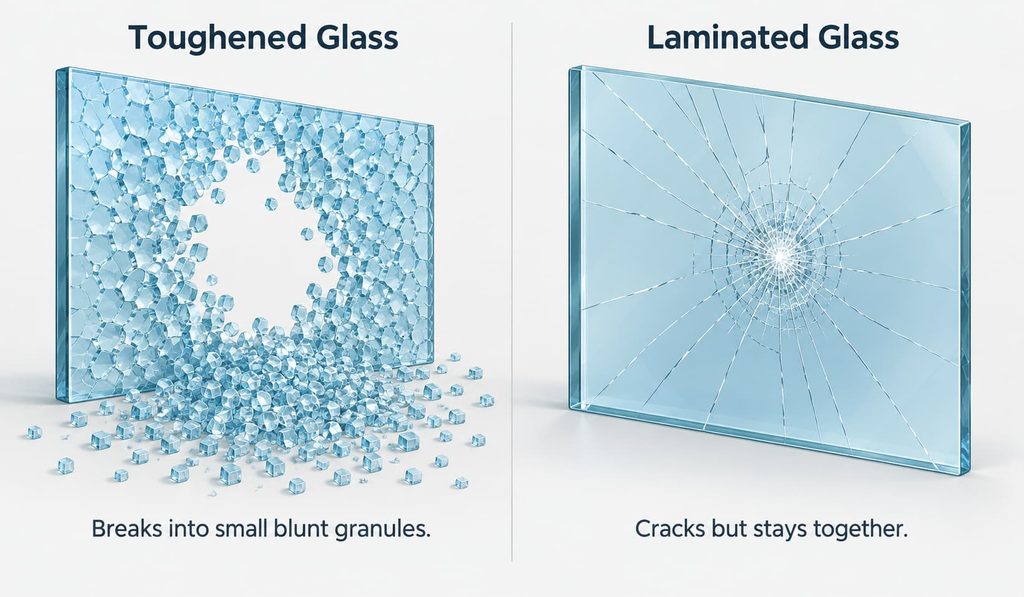
Toughened glass is heat-strengthened glass that is about four to five times stronger than ordinary glass and breaks into small, blunt granules. Laminated glass is two or more glass sheets bonded around a plastic interlayer, so it cracks but holds together and stays in the frame. Both are safety glass; the difference is how they behave when they break.
| Feature | Toughened glass | Laminated glass |
|---|---|---|
| How it’s made | Heated, then rapidly cooled | Two sheets bonded with an interlayer |
| Strength | About 4–5× ordinary glass | Lower per pane, but stays intact |
| When it breaks | Small blunt granules; whole panel lets go | Cracks in a web but holds together |
| Safety grade | Grade A | Grade A |
| Extra benefits | — | Cuts noise, blocks most UV, better security |
| Cut after making? | No | Yes, if not toughened |
What is toughened glass?
Toughened glass, also called tempered glass, is ordinary glass that has been heated and then rapidly cooled. This makes it about four to five times stronger than ordinary glass of the same thickness. If it breaks, it shatters into small, blunt granules rather than sharp shards, which lowers the risk of injury. It cannot be cut or drilled once it is toughened.
What is laminated glass?
Laminated glass is two or more sheets of glass bonded around a tough plastic interlayer (usually PVB, or stiffer SGP for higher-strength jobs). When it breaks, the interlayer holds the pieces in place, so the glass cracks in a spider-web pattern but stays in the frame. This makes it good for security and containment. Laminated glass also reduces outside noise and blocks most UV light, which toughened glass alone does not.
How is each type of glass made?
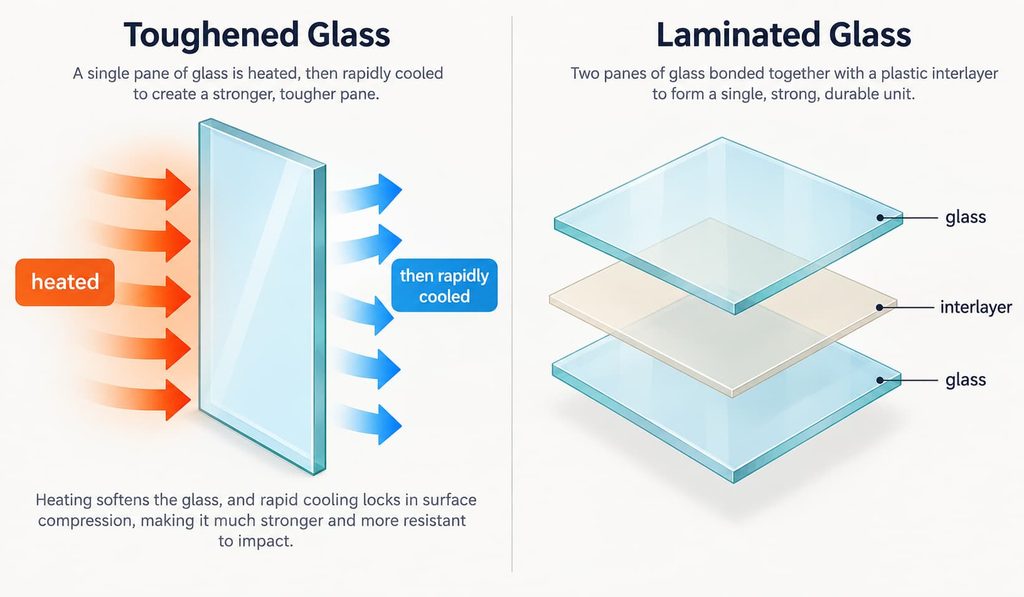
Toughened and laminated glass both start as ordinary annealed float glass but are finished in very different ways. Toughened glass is heated in a furnace to over 600°C, then cooled quickly with jets of air, which locks in stress that makes it much stronger. Laminated glass is built up by bonding two glass sheets around a plastic interlayer under heat and pressure.
Because toughening locks in this stress, toughened glass cannot be cut, drilled or edge-worked afterwards, so all shaping is done first. Laminated glass can still be cut if its layers are ordinary annealed glass, but not if the layers are already toughened. This is why toughened panels are always made to their exact final size before treatment.
Which is stronger, and which is safer?
Toughened glass is stronger against a single impact, but that does not make it safer for every job. A toughened panel resists more force before it breaks, yet once it goes, the whole panel lets go at once. Laminated glass may break more easily, but it keeps working as a barrier after it cracks, because the interlayer holds it together.
So “stronger” and “safer” are not the same thing. For impact resistance and safe breakage at ground level, toughened wins. For containment, keeping glass in place, resisting intrusion, or stopping a fall, laminated is the safer choice. Both are Grade A safety glass, so both are safe when used in the right place.
Which glass do you need?
The right glass depends on the job. As a rule, choose toughened glass for wet areas and impact zones at ground level, and laminated glass where the glass must stay in place if it breaks. In some spots either type is allowed; in a few, only laminated will do. The guide below shows the usual choice for each application.
- Use toughened glass for shower screens, splashbacks, pool fencing and most ground-level impact zones.
- Use laminated glass for overhead glazing, security, noise reduction, and balustrades that must hold if a panel breaks.
Shower screens and splashbacks: toughened
Toughened glass is the standard choice for shower screens and splashbacks, because it handles knocks and heat well and breaks safely into blunt granules. Design Inferno’s glass shower screens and glass splashbacks use toughened safety glass. Behind a cooktop, toughened glass also copes with the heat far better than ordinary glass.
Pool fencing: toughened
Glass pool fencing uses toughened safety glass because it must resist impact outdoors and break safely if struck. It stands up to weather, pool chemicals and knocks. Design Inferno’s glass pool fencing is made from toughened glass and fixed with stainless hardware to meet the pool-safety rules.
Balustrades: toughened or laminated
Glass balustrades can use toughened or laminated glass, depending on the fall height and design. Toughened glass suits many stair and balcony balustrades. Laminated, or toughened-laminated, is used for higher falls and for frameless designs without a top handrail, because it stays in place if a panel breaks. Design Inferno’s glass balustrades are specified to suit the site.
Overhead glazing, security and acoustic uses: laminated
Laminated glass is required for sloped overhead glazing under AS 1288, because glass above your head must not fall if it breaks. Laminated is also the choice for security, where its resistance to intrusion matters, and for cutting outside noise. Where a job needs both strength and containment, toughened-laminated glass gives both at once.
Wardrobe doors and mirrors: toughened
Glass and mirror wardrobe doors use toughened safety glass or safety-backed mirror, so they break safely in a bedroom. Design Inferno’s glass wardrobe doors are made from safety glass in a range of colours and finishes.
What is toughened-laminated glass?
Toughened-laminated glass combines the two types: toughened glass sheets bonded around a plastic interlayer. It has the strength of toughening and the “stays together” safety of lamination, so it resists impact and holds in place if it breaks. It is the premium choice for frameless balustrades without a handrail, for higher falls, and for demanding security or overhead uses.
What are the Australian standards for safety glass?
Two Australian Standards govern safety glass. AS 1288:2021 sets out where safety glass is required and which type will do, from shower screens to overhead glazing. AS/NZS 2208 covers the grading and marking of the glass itself, which is why safety glass carries a permanent etched stamp in one corner. AS 1288 is a primary reference document in the National Construction Code.
Both toughened and laminated glass count as Grade A safety glass when they are made to AS/NZS 2208. In most human-impact locations, either type is allowed. In a few higher-risk spots, such as sloped overhead glazing, only laminated glass will do. A glazier or building surveyor works to these rules when specifying the glass for a job.
The bottom line
Toughened and laminated glass are both Grade A safety glass, but they suit different jobs. Toughened is stronger and breaks into safe granules, so it is used for shower screens, splashbacks and pool fencing. Laminated holds together when it breaks, so it is used overhead, for security and for noise reduction. Toughened-laminated gives both, and a good glazier will match the glass to the job.
Design Inferno designs, manufactures and installs custom glass across Melbourne from its factory and showroom in Keilor Park, choosing the right safety glass for each product. Book a free measure and quote to talk through the best glass for your project.
Frequently asked questions
Toughened glass is stronger against a single impact, about four to five times stronger than ordinary glass of the same thickness. Laminated glass has a lower break point per pane, but it keeps working as a barrier after it cracks, because the interlayer holds the pieces together. So toughened is stronger, while laminated glass stays intact.
Both are Grade A safety glass, so both are safe when used correctly, but they protect differently. Toughened glass breaks into small, blunt granules that are unlikely to cause serious cuts. Laminated glass stays in the frame when broken, which is safer where the glass must contain a fall, resist intrusion, or stay overhead.
No. Toughened glass cannot be cut, drilled or edge-worked once it has been toughened, because that would cause it to shatter. All cutting, shaping and hole-drilling must be done before the glass is heat-treated. This is why toughened glass is always made to its exact final size for the job.
Laminated glass usually costs more than toughened glass of the same size, because it uses two or more sheets and a plastic interlayer, and it is heavier. The extra cost buys containment, security and noise reduction. For jobs where the glass must stay in place if it breaks, that trade-off is worth it.
Toughened glass can, rarely, break with no obvious cause. This is usually due to tiny nickel sulphide inclusions left from manufacturing, sudden temperature changes, or edge damage. Modern processes reduce the risk but cannot remove it entirely. Heat-soaking is an extra treatment that lowers the chance of this spontaneous breakage.
