
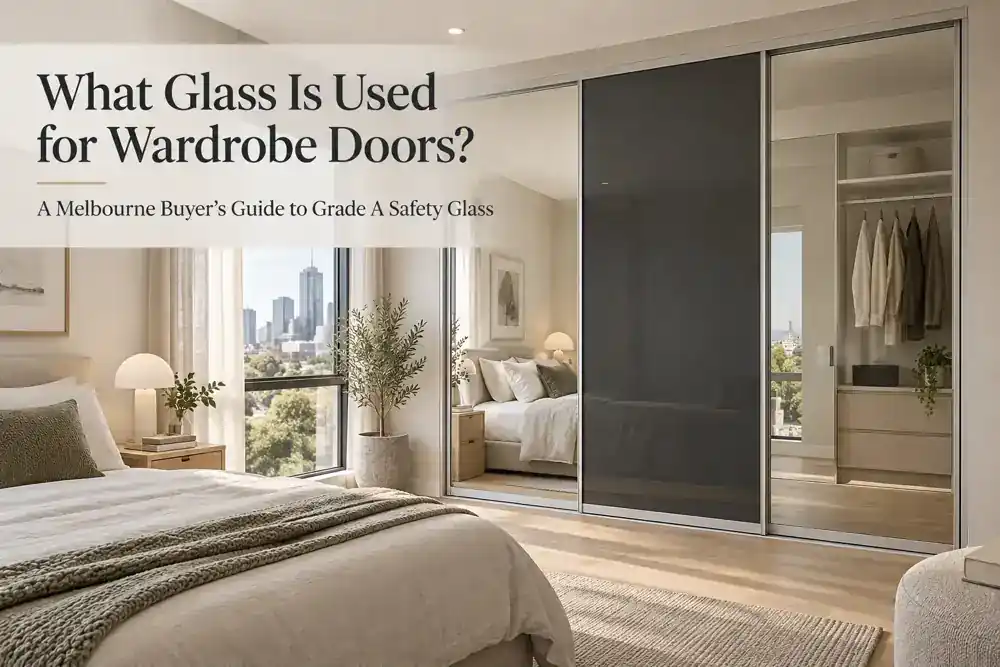
Wardrobe doors use Grade A safety glass: glass that meets Australian safety rules. In practice, that means toughened glass for clear, coloured or textured panels, and safety-backed mirror for mirror doors. Both stand up to daily use and break safely. Ordinary glass is not allowed, because a wardrobe door is a door, and AS 1288 requires safety glass in all doors.
Key takeaways
- Wardrobe doors must use Grade A safety glass because AS 1288 requires safety glass in all doors.
- Toughened glass is the standard choice for clear, coloured and textured wardrobe door panels.
- Mirror wardrobe doors use safety-backed mirror, which holds together if it breaks.
- Options include clear, low-iron, tinted, back-painted (coloured) and textured glass.
- Wardrobe door glass is typically 4 to 6mm thick.
- Grade A safety glass carries a permanent etched mark and meets AS/NZS 2208.
What glass is used for wardrobe doors?
Grade A safety glass is glass that passes the AS/NZS 2208 impact test, so it breaks safely, either toughened glass or laminated glass. Wardrobe doors use it in a few forms: toughened clear or low-iron glass, safety-backed mirror, back-painted coloured glass, and textured glass. Ordinary annealed glass is not permitted in a door.
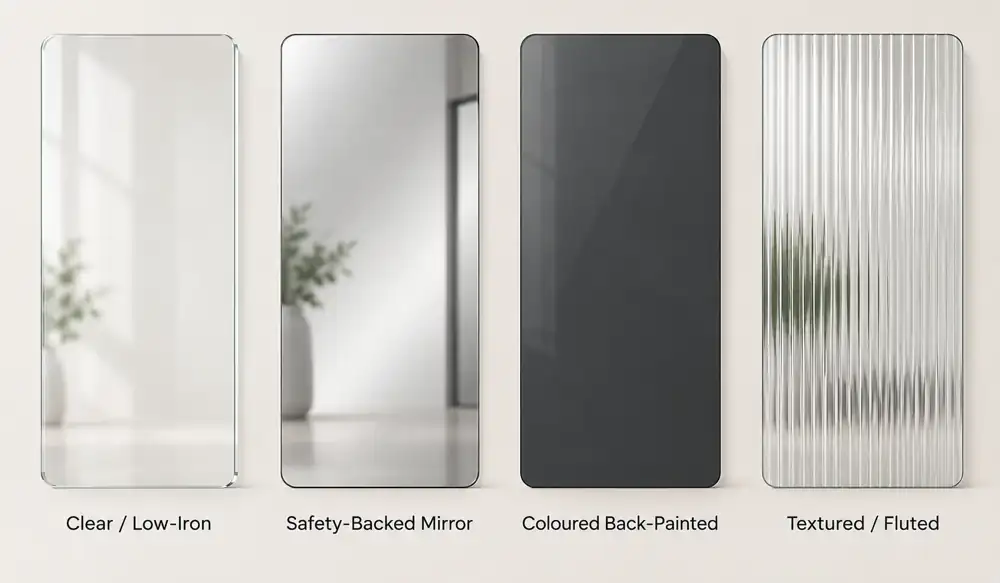
| Option | What it is | Best for |
|---|---|---|
| Clear / low-iron | Toughened clear glass (low-iron is extra clear) | A light, minimal look |
| Safety-backed mirror | Silvered glass with a safety backing | Reflection; making a room feel bigger |
| Coloured (back-painted) | Toughened glass painted on the back | Any custom colour to match cabinetry |
| Textured/frosted | Patterned or frosted safety glass | Privacy and style |
| Tinted | Grey or bronze tinted safety glass | A softer, moody look |
Do wardrobe doors need safety glass?
Yes. Wardrobe doors need Grade A safety glass because they are doors, and AS 1288, the Australian Standard for glass in buildings, requires safety glass in all hinged, sliding and bifold doors. Wardrobe doors are opened, closed and leaned on every day in a bedroom, so the glass must break safely if it ever fails. Ordinary annealed float glass breaks into large, dangerous shards.
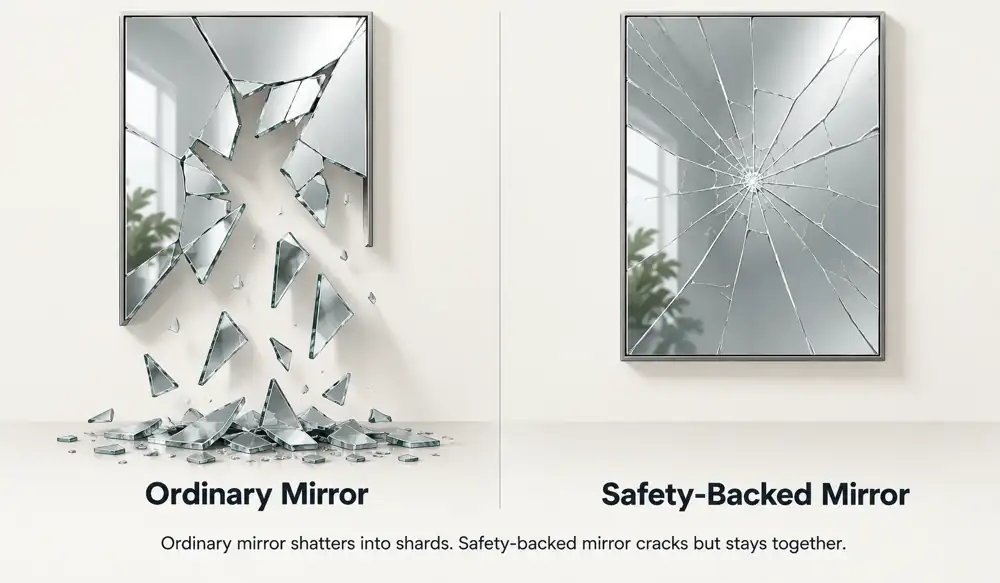
A mirror on a wardrobe door has its own rule. An ordinary mirror is only allowed when it is fixed flat to a solid wall. On a moving door, it must be a safety-backed (organic- or vinyl-backed) mirror, which has a backing film that holds the pieces together if the glass breaks. This is why quality mirror wardrobe doors always use safety-backed mirror.
The glass and mirror options explained
Wardrobe door glass comes in several looks, and all of them are made as Grade A safety glass. The right one depends on the style you want, how much light you need, and whether you want privacy. Below are the main options and where each works best.
Clear and low-iron glass
Clear toughened glass gives a light, minimal look and lets you see the interior of the robe. Standard clear glass has a faint green tint on the edges, while low-iron glass is extra clear and shows truer colours. Low-iron is worth choosing where the glass sits over pale interiors or a painted back, so the colour reads accurately.
Safety-backed mirror
Mirror is silvered glass and the most popular wardrobe door glass, because it adds a full-length mirror without using floor space and makes a room feel larger and brighter. On a door, it must be safety-backed so it holds together if broken. Design Inferno’s mirror wardrobe doors use safety-backed mirror and can be clear, grey or bronze-tinted.
Coloured (back-painted) glass
Back-painted glass is toughened glass with a colour painted on the back, so the front stays glossy and easy to clean. It can be made in almost any shade to match your cabinetry or walls. You can preview colours on the colour simulator before you order a set of custom glass wardrobe doors.
Textured and frosted glass
Textured or frosted glass adds privacy and style, softening the view of the robe interior while still letting light through. Fluted and reeded patterns are on trend, and frosting can be full or partial. Like the other options, textured wardrobe door glass is toughened to meet the safety-glass rules.
How thick is wardrobe door glass?
Wardrobe door glass is usually 4 to 6mm thick. The exact thickness depends on the panel size and the door system: framed doors can use thinner glass because the frame supports it, while larger frameless or sliding panels use 6mm for rigidity. Safety glass also has maximum panel-size limits by thickness under AS 1288, which your maker works to when sizing the doors.
What is Grade A safety glass?
Grade A safety glass is glass that has passed the impact test in AS/NZS 2208, so it breaks safely. It is either toughened glass (also called tempered), which crumbles into small blunt cubes, or laminated glass, which holds together on a plastic interlayer. Wardrobe doors use toughened glass and safety-backed mirror. For a deeper look at the two types, see our guide to toughened vs laminated glass.
You can usually tell safety glass by its mark. Grade A safety glass carries a permanent etched stamp in one corner, showing the standard (AS/NZS 2208) and the grade. If you cannot find a mark, ask your supplier for proof. A reputable custom glass maker only fits compliant safety glass, so this is rarely a concern.
Choosing wardrobe door glass in Melbourne
For Melbourne buyers, the biggest advantage is custom glass made to your colour and size. A local maker can match a back-painted glass to your cabinetry, cut safety-backed mirror to your opening, and fit compliant Grade A safety glass. Seeing a colour in your own light matters, so preview shades on the colour simulator and browse finished robes in the project gallery before you decide.
When you compare quotes, check three things: that the glass is Grade A safety glass with its mark, that mirror doors use safety-backed mirror, and that the glass is made to size for your opening. A custom maker handles all three, so the doors fit cleanly and meet the safety rules from the start.
The bottom line
Wardrobe doors use Grade A safety glass: toughened glass for clear, coloured and textured panels, and safety-backed mirror for mirror doors. This keeps a bedroom safe and gives you a wide choice of looks, from a full-length mirror to a custom back-painted colour. Check that the glass carries its safety mark and is made to size for your opening.
Design Inferno designs, manufactures and installs custom glass and mirror wardrobe doors across Melbourne from its factory and showroom in Keilor Park, in Grade A safety glass and almost any colour. Book a free measure and quote to plan wardrobe doors that suit your room.
Frequently asked questions
Wardrobe doors use Grade A safety glass. In practice, that means toughened glass for clear, coloured (back-painted) and textured panels, and safety-backed mirror for mirror doors. All of these break safely and meet AS 1288. Ordinary annealed glass is not allowed in a wardrobe door, because it breaks into dangerous shards.
Yes. A wardrobe door is a door, and AS 1288 requires Grade A safety glass in all doors, including sliding and hinged robe doors. This keeps a bedroom safe if the glass is ever knocked or broken. A reputable maker will only fit compliant safety glass, and it carries a permanent etched safety mark.
It should be. A mirror on a moving wardrobe door must be a safety-backed (organic-backed) mirror, which has a backing that holds the pieces together if it breaks. An ordinary mirror is only allowed when it is fixed flat to a solid wall, not on a door. Always confirm mirror doors use a safety-backed mirror.
Yes. Coloured wardrobe doors use back-painted glass: toughened glass with a colour painted on the back. It can be made in almost any shade, including custom colours matched to your cabinetry. The glossy front is easy to clean, and the colour will not fade like a printed film. A colour simulator helps you preview a shade first.
Wardrobe door glass is usually 4 to 6mm thick. Framed doors can use thinner glass because the frame gives support, while larger sliding or frameless panels use 6mm for rigidity. Your maker chooses the thickness to suit the panel size and to stay within the safety-glass panel-size limits in AS 1288.
