
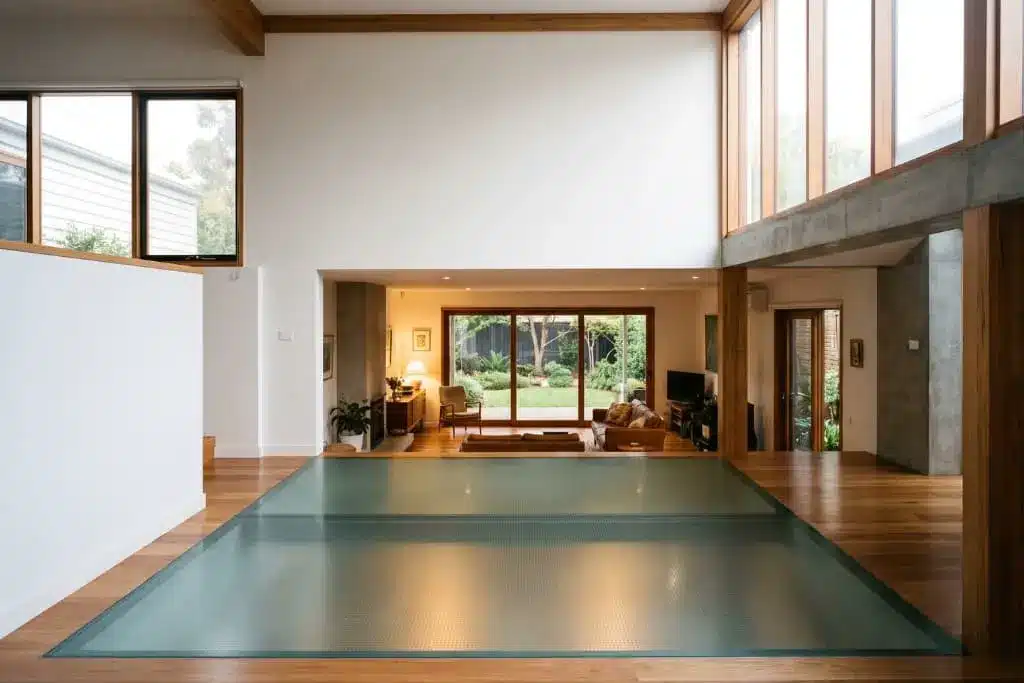
Plain polished glass is slippery when wet, in the same way polished stone and gloss tiles are. A finished glass floor does not have to be. Glass floor slip resistance comes from the top surface, so sandblasting, acid etching and ceramic frit dots all add texture, and that texture is rated under AS 4586, the same slip test used for tiles. Ask for the P rating before you buy.
Key takeaways
- Untreated polished glass has poor grip once it is wet, so a bare panel is not a finished floor.
- Anti-slip finishes work by texturing the top surface: sandblasting, acid etching, ceramic frit dots or an applied coating.
- Australia rates slip resistance under AS 4586, using the wet pendulum test (P0 to P5) or the oil-wet ramp test (R9 to R13).
- Under the NCC, stair treads need P3 dry or P4 wet, and a ramp not steeper than 1:8 needs P4 dry or P5 wet.
- A flat internal floor is not covered by those NCC clauses, but the same ratings are still the sensible way to specify it.
- Design Inferno glass floors are 30mm to 40mm thick for internal home use, with a 6mm sacrificial layer and a slip resistance coating available.
- Grip changes over time, so cleaning products and site wear matter as much as the original finish.
Why polished glass loses grip when it is wet
A polished glass surface offers very little grip once water, dust or cleaning residue is on it, which is exactly why walk-on glass is never left polished. The finished product has a treated top face, and that face is what you specify.
It helps to separate two things that often get muddled. Panel strength and glass floor slip resistance are unrelated. A glass floor can be strong enough to park a car on and still be slippery, because thickness deals with load and surface texture deals with traction. You have to sort out both.
Slip resistance simply means how much friction a surface gives your shoe or bare foot before it slides. Every floor material has a rating for it. Polished porcelain, honed marble, sealed concrete and glass all sit at the low grip end when they are smooth and wet, and all of them can be brought up the scale by changing the surface.
Design Inferno manufactures glass floors to measure at our Keilor Park workshop, and slip resistance is part of the specification on every job rather than an afterthought.
Tip: If a supplier cannot tell you the slip classification of the finish they are quoting, they have not tested it. Ask for the test report, not a description.
How is glass floor slip resistance measured in Australia?
Australia classifies slip resistance under AS 4586 for new surfaces and AS 4663 for floors already installed, with the wet pendulum test producing a P rating and the oil-wet ramp test producing an R rating. Both appear on product documents.
The two tests measure different things, so you cannot convert one into the other. Choose the one that reflects how the floor will actually be used, then ask for a result in that scale.
The wet pendulum test and P ratings
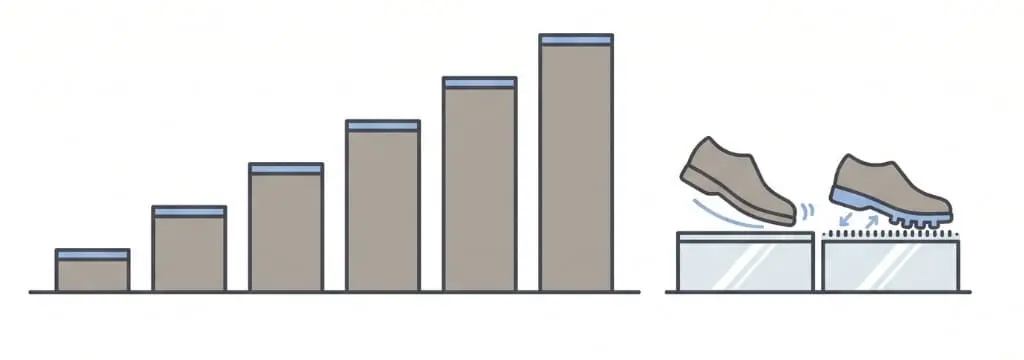
A weighted arm fitted with a rubber slider swings across a wet sample and loses speed as it drags. That loss is recorded as a Slip Resistance Value, or SRV, and the SRV falls into one of six bands.
| Class | SRV, slider 96 | Plain English |
|---|---|---|
| P5 | Above 54 | Highest grip, for the wettest and steepest surfaces |
| P4 | 45 to 54 | High grip, typical for wet areas and external surfaces |
| P3 | 35 to 44 | Moderate grip, common for internal stair treads |
| P2 | 25 to 34 | Low grip |
| P1 | 12 to 24 | Very low grip |
| P0 | Below 12 | Effectively no grip when wet |
The pendulum test is portable, which matters more than it sounds. It is the one test that can be repeated on your floor after installation, and again in five years, to see whether the finish is still performing.
The oil-wet ramp test and R ratings
Here, an operator in safety boots walks up and down a test surface covered in oil while the slope is gradually increased. The angle at which they slip sets the class: R9 from 6 degrees, R10 from 10, R11 from 19, R12 from 27 and R13 from 35 degrees and above.
R ratings suit commercial kitchens, workshops and industrial areas where oil and grease are the real contaminants. For a home, the wet pendulum P rating is usually the more meaningful number, because water is what you will be dealing with.
A third scale turns up on pool surrounds. The wet barefoot ramp test grades surfaces A, B or C, which is the one to ask about if the glass sits anywhere people walk without shoes.
What slip rating does a glass floor need?
The National Construction Code sets slip resistance minimums for stair treads, nosings, landings and ramps, and those figures are the sensible benchmark for glass floor slip resistance even where the code does not strictly apply. Flat internal floors are not covered by the same clauses.
For houses, Table 11.2.4 of the ABCB Housing Provisions sets out the minimums.
| Surface | Dry conditions | Wet conditions |
|---|---|---|
| Stair tread | P3 or R10 | P4 or R11 |
| Nosing or landing edge strip | P3 or R10 | P4 or R11 |
| Ramp not steeper than 1:8 | P4 or R10 | P5 or R12 |
A “wet” surface in this context means one that is normally wet or likely to be made wet, including anything exposed to the weather. A “dry” surface is one that only gets wet by accident, such as a spilt drink.
Beyond stairs and ramps, the guidance sits in two Standards Australia handbooks, SA HB 197 and SA HB 198. Neither is mandatory, but both are what specifiers use to pick a target class for a given room, and both are worth quoting in a brief. As a rough guide for a home:
- Internal glass floor, dry living area. P3 is a reasonable working target for a walking surface.
- Internal glass floor near a wet zone, such as an entry, laundry or bathroom threshold. Aim for P4.
- External or undercover glass floor, such as a balcony or terrace panel. P4 as a minimum, since it will be rained on.
- Glass stair treads. Follow the code table above and treat it as the floor, not the guidance.
Tip: Write the class you want into the quote. “Anti-slip finish” is not a specification. “Sandblasted top surface, classified P4 to AS 4586 wet pendulum” is.
What anti-slip options are available for glass floors?
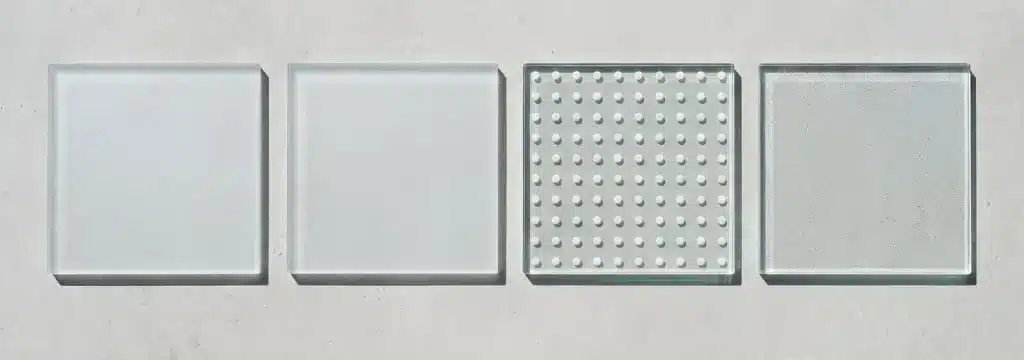
The four common approaches are sandblasting, acid etching, fired ceramic frit and an applied coating, and the first three change the glass itself rather than sitting on top of it. That difference is the reason they last.
Sandblasted glass
Fine abrasive is fired at the top surface under pressure, leaving a uniformly matt, lightly rough face. It is the standard option for structural walk-on glass and gives the most grip of the etched finishes, with a full coverage sandblasted surface commonly testing around an SRV of 50 wet, which lands in the P4 band.
The finish is translucent rather than clear, so light still comes through, but you lose the see-through view. In a floor panel over a stairwell or a lower level, many people prefer that. It removes the vertigo and the modesty problem in one go.
Acid etched glass
Acid etching produces a similar frosted look with a finer, smoother texture than sandblasting. It is easier to keep clean and feels less coarse underfoot, which suits bare feet, but it gives less grip than a full sandblast. It is a reasonable choice for a dry internal panel and a weak one for a wet area.
Ceramic frit dots
Ceramic frit is a glass based ink screen printed onto the surface and then fired in during toughening, so it becomes part of the panel and cannot wear off or peel. It is usually printed as a dot matrix. Coverage generally needs to exceed about 40 per cent of the surface for a meaningful slip result.
The appeal is that you keep clarity between the dots. Look down, and you still see through the floor, while your shoe lands on textured ceramic. Frit can also be printed in a colour or pattern, which turns the safety feature into a design one.
Applied anti-slip coatings
A coating is sprayed or rolled onto finished glass. It is the cheapest route and the only one that can be applied to a floor already installed, which is its real use case. Retrofitting grip to an existing glass floor without pulling panels out is a genuine advantage.
The trade off is durability. A coating sits on the surface, so foot traffic, grit and cleaning slowly wear it away, and it will need reapplying. Treat it as maintenance rather than a permanent fix.
| Finish | How it works | Typical look | Durability | Best for |
|---|---|---|---|---|
| Sandblasted | Abrasive roughens the top face | Matt, translucent, no view through | Permanent, part of the glass | Wet areas, external panels, highest grip |
| Acid etched | Acid frosts the top face | Fine frosted, translucent | Permanent, part of the glass | Dry internal floors, bare feet |
| Ceramic frit dots | Fired ceramic ink printed in a pattern | Clear between dots, view retained | Permanent, fired in during toughening | Feature floors where you want to see through |
| Applied coating | Textured layer applied over the glass | Near invisible | Wears with traffic, needs reapplying | Retrofitting grip to an existing floor |
What else makes a walk-on glass floor safe?
Grip is one of four things that make a glass floor safe, alongside the glass build-up, the sacrificial layer and the way the panel is supported. A P5 surface on an underspecified panel is not a safe floor.
Walk-on glass is built as toughened laminated glass, which is several sheets bonded together with a tough interlayer. If one sheet ever breaks, the interlayer holds the fragments in place and the remaining sheets carry the load. Nobody falls through. That behaviour is the whole reason floors are laminated rather than monolithic.
The top sheet is usually a sacrificial layer, a replaceable pane that takes the scratches, chips and wear so the structural sheets underneath stay intact. When it eventually looks tired, you replace that layer rather than the whole floor. Design Inferno glass floors for internal home use are 30mm to 40mm thick overall with a 6mm sacrificial layer.
Glass selection and installation in Australian buildings is governed by AS 1288:2021, Glass in buildings, and the safety glass itself is made to AS/NZS 2208. Any overhead glazing in a walkable area has to be Grade A safety glass. Add to that the load requirements in AS/NZS 1170.1, and the panel thickness for a given span stops being a matter of opinion.
Two site details are worth raising early with whoever is doing your floor:
- Edge and frame detail. How the glass meets the surrounding floor sets the trip risk. A flush, level transition is worth insisting on.
- Drainage and run-off. Water that pools on a glass panel is the single most common cause of a slip. Falls, drainage, and a mat at the entry do more good than a higher rating.
Where do glass floors get slippery in a real home?
Almost every slip happens in a predictable spot, and knowing them lets you fix the design instead of the surface. Water, dust and footwear do most of the damage.
| Situation | What goes wrong | What to do |
|---|---|---|
| Entry or hallway panel | Wet shoes track rain straight onto the glass | Specify P4, add an entry mat, keep the panel back from the door |
| Bathroom or laundry threshold | Splash and condensation sit on the surface | Specify P4 and slope the surrounding floor away from the panel |
| Balcony or terrace panel | Rain, dew and pollen build a slick film | P4 minimum, plus regular cleaning, since grime lowers grip over time |
| Panel in bare feet or socks | Socks on smooth glass have almost no grip | Consider a wet barefoot rating and a sandblasted rather than etched finish |
| Stair tread or landing | The consequence of a slip is a fall, not a stumble | Meet the NCC classification and add a nosing with its own rating |
| Sunroom or north facing panel | Glare hides water and edges | Use a matt finish, which scatters light and reads more clearly underfoot |
| Kitchen adjacent panel | Oil and grease, not just water | Ask for an R rating as well as a P rating |
You can see completed glass flooring work in the gallery.
How do you keep a glass floor slip resistant?
Rinse with warm water, wash with a mild detergent and a soft cloth or microfibre mop, then dry off the surface. No polish, no wax, no oil-based cleaner.
That last part is the one that catches people out. Products sold to make glass gleam leave a thin film, and a film is precisely what undoes glass floor slip resistance. Anything marketed as “shine”, “buffing” or “leave-on” belongs on a window, not underfoot.
The four-step routine
- Sweep or vacuum the panel first. Grit is the main thing that wears a textured finish, so lift it off before you introduce water.
- Rinse with warm water. This loosens the film without pushing dry grit across the surface.
- Wash with a mild detergent and a soft cloth or microfibre mop. Work in one direction and rinse the cloth often, so you lift the residue rather than spread it.
- Dry the panel off. A squeegee or a dry microfibre cloth removes the water marks and returns the surface to full grip straight away.
Monthly is enough for most internal floors. An external or undercover panel needs it more often, because rain and pollen build a film that quietly lowers the rating.
- Skip abrasive pads and scourers. On a sandblasted or etched surface, they polish the peaks off the texture and quietly reduce the grip.
- Get grit off quickly. Sand and dust act like sandpaper under shoes, wearing the finish and scratching the sacrificial layer.
- Dry the panel after washing. A wet floor left to air dry is the most slippery it will ever be in normal use.
- Recoat on schedule. If you have an applied coating, ask the installer for the expected life and put a reminder in the calendar.
- Retest if in doubt. AS 4663 covers in-situ testing of existing floors, so a portable wet pendulum test can tell you what your floor is doing now rather than what it did new.
More answers sit on our frequently asked questions page and across the Design Inferno blog.
What does an anti-slip glass floor cost in Melbourne?
Glass flooring from Design Inferno starts from around $2,500, with the finish, the panel size, the glass build-up and the support detail all moving the figure. Every floor is measured and quoted.
The anti-slip finish itself is rarely the biggest line. Panel size and thickness usually are, because both are set by the span and the load the floor has to carry. Where the finish does bite is in the choice between a fired treatment and a coating, and between full coverage and a partial pattern.
Five things move a quote:
- Panel size and span. A longer unsupported span needs a thicker build-up, and thickness drives cost more than anything else.
- Glass type. Starphire for maximum clarity, clear, frosted, or printed and painted, each priced differently.
- Anti-slip finish. Sandblasting, acid etching, ceramic frit and coatings all sit at different price points, with frit printing the dearest.
- Support and framing. An existing steel or timber opening is straightforward. New structure, flush thresholds and concealed frames add cost.
- Access. Glass floor panels are heavy. Upper levels, tight stairwells and difficult lifts add time and equipment.
A measure and quote takes the guesswork out of it. Book a free consultation or call the Keilor Park showroom on 03 9336 7703. We measure and install across our Melbourne service areas.
Frequently asked questions
Untreated polished glass is, in the same way as polished stone and gloss tiles are. A finished glass floor has a textured top surface produced by sandblasting, acid etching or fired ceramic frit, and that surface can be classified as slip resistant under AS 4586. Ask for the tested classification rather than a description.
For an internal dry area, P3 is a reasonable working target. For an entry, bathroom threshold or any external panel, aim for P4. Glass stair treads should meet the National Construction Code minimum of P3 in dry conditions and P4 in wet conditions.
A P rating comes from the wet pendulum test and reflects grip on a water-wet surface, which is what matters in a home. An R rating comes from the oil-wet ramp test and reflects grip where oil and grease are present, such as a commercial kitchen. They measure different things and cannot be converted.
Sandblasting gives the most grip and is the usual choice for wet or external panels. Ceramic frit dots keep the view through the glass while adding traction, which suits feature floors. Acid etching suits dry internal areas. A coating is best kept for retrofitting an existing floor.
Sandblasting, acid etching and fired ceramic frit are part of the glass, so they do not peel or wash away, though heavy traffic and abrasive cleaning can gradually smooth the texture. Applied coatings sit on the surface and will wear with use, so they need reapplying.
Yes. An applied anti-slip coating can be put onto a floor that is already installed, and some etching treatments can be done in place. Both are less durable than a factory finish, so ask for the expected life and a plan for reapplying.
Design Inferno glass floors for internal home use are 30mm to 40mm thick, made up as toughened laminated glass with a 6mm sacrificial top layer. The exact build-up depends on the span, the load and how the panel is supported.
They can be, provided the surface classification suits the room, and the panel is designed to the right load. Bare feet and socks change the picture, so ask about a wet barefoot rating as well, and choose a sandblasted rather than an acid-etched surface where people walk unshod.
Stair treads, nosings, landings and ramps have slip resistance classifications set by the code. A flat internal floor is not covered by those clauses, but the glass itself must comply with AS 1288:2021 and AS/NZS 2208, and the same classifications are the sensible way to specify the surface.
