
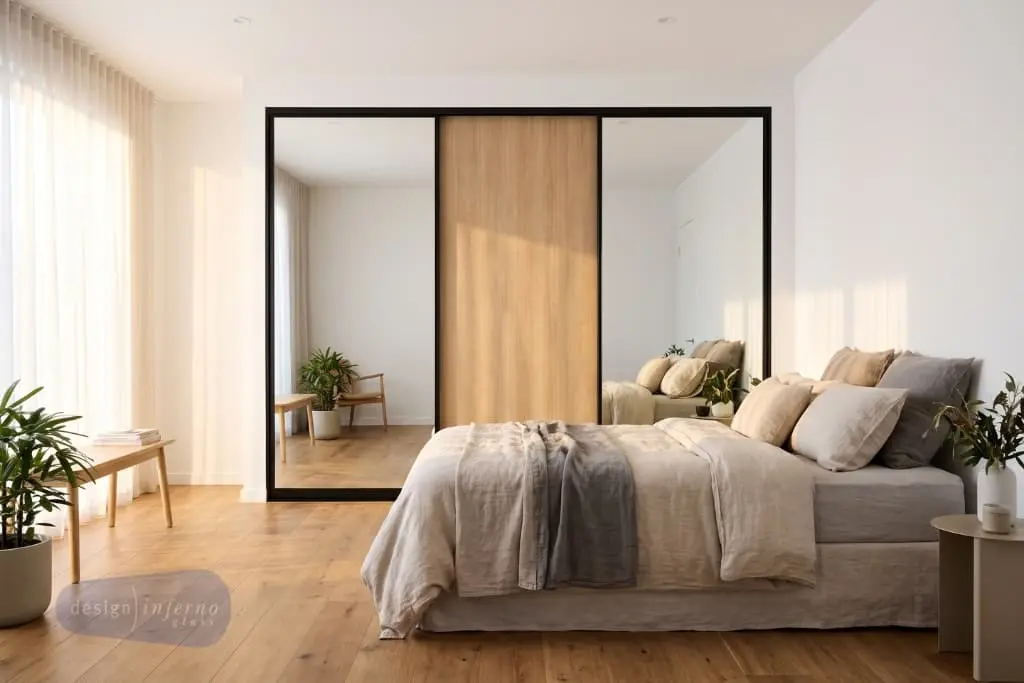
Mirror wardrobe doors bounce light around and make a small bedroom feel bigger, but they show every fingerprint. Tinted glass softens the reflection and calms the wall down. Colour-backed glass gives a solid painted panel that hides everything inside and matches your joinery. Choose based on how much daylight the room gets, how much reflection you actually want to live with, and how much cleaning you will put up with.
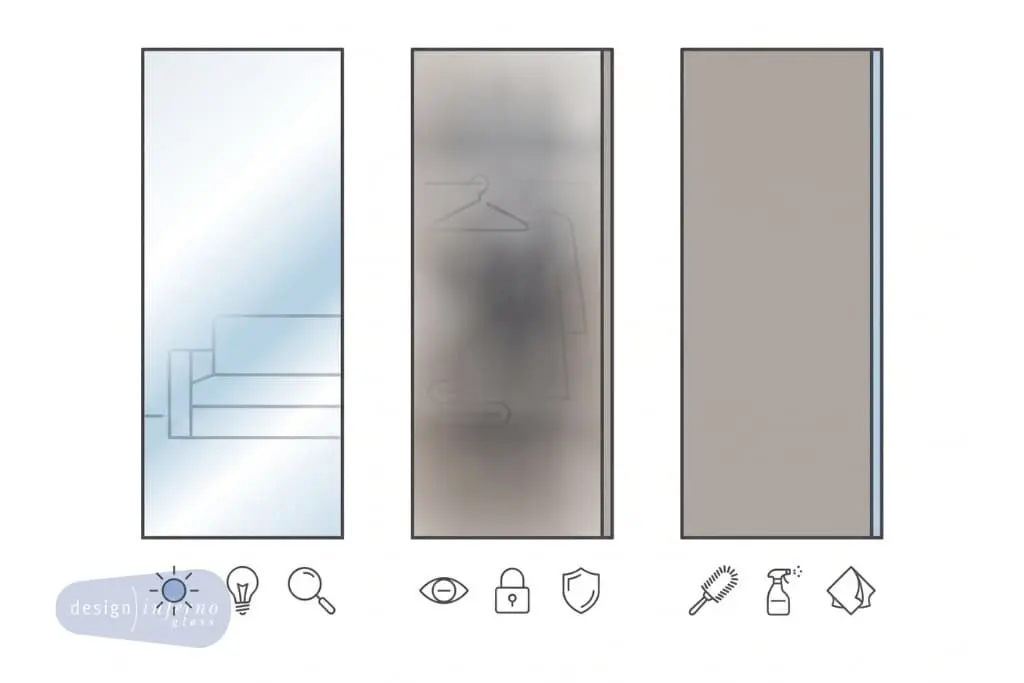
Key takeaways
- Mirror gives the most light and the strongest sense of space, and it costs you the most in cleaning.
- Tinted glass sits in the middle: softer reflection, calmer look, far more forgiving of fingerprints.
- Colour back glass is painted on the back of the glass, so it is fully opaque and hides everything inside.
- Small, dark or single window bedrooms almost always gain from a mirror on at least one panel.
- Rooms with strong afternoon sun, or a wardrobe facing the bed, usually read better in tint or colour.
- Every glass panel should be safety backed or toughened, so a knock cannot send shards across the floor.
- Frame type changes the look as much as the finish does: traditional, semi-frameless, frameless and shoji all read differently.
- Design Inferno glass wardrobe doors start from $450, custom-made in Melbourne and professionally installed
What are the three glass wardrobe door finishes?
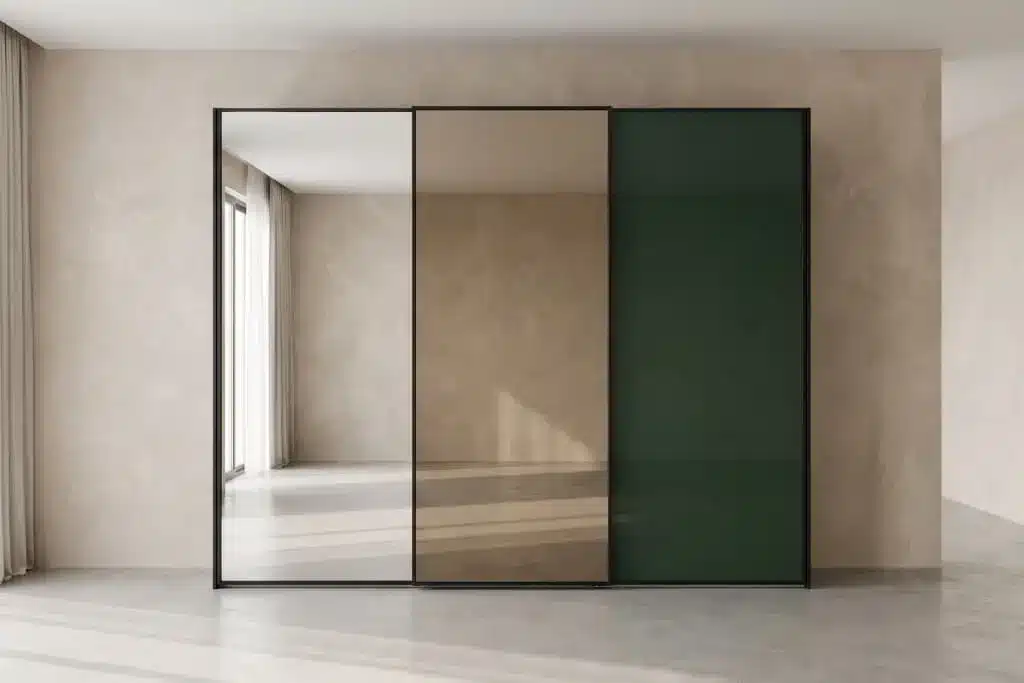
Mirror, tinted glass and colour back glass are the three glass finishes used on wardrobe doors, and they differ in how much light they return to the room and how much of the wardrobe they hide. Everything else, including frames and tracks, sits on top of that choice.
It helps to think of the wardrobe wall as one of the largest surfaces in the bedroom. In most Australian homes it runs floor to ceiling across a full wall, so whatever you put on it sets the mood of the room more than the bedhead or the rug does. That is why the final decision is worth slowing down on.
Design Inferno also makes wardrobe doors in MDF and vinyl, which are worth knowing about but behave differently. They are solid panels rather than glass, so they do not carry light, and they cannot be made in a mirror or a glass gloss. This article stays with the three glass options.
Mirror
Silver mirror with a safety backing bonded to the rear face. It reflects the room back at you, doubles the apparent depth of the space and returns daylight to the darker corners. Available as standard silver, and in smoked, grey and bronze mirror if you want the effect without the brightness.
Tinted glass
Clear glass coloured through the sheet, usually in grey, bronze, smoke or near black. It reflects far less than mirror and reads as a soft, moody panel rather than a bright one. Depending on the tint and the backing, you may see a faint shadow of what sits inside when a light is on behind it.
Colour back glass
Clear or low iron glass with a colour applied to the back face and cured. The result is a solid, opaque panel with a glass surface in front of it, so you get depth and a wipe-clean face without any view through. It is the closest thing to a painted joinery door, only tougher and easier to keep clean.
Tip: You do not have to pick one finish for the whole wardrobe. Mixing a mirrored panel with two colour back panels is common, and it usually gives a better result than a full wall of mirror.
When do mirror wardrobe doors work best?
Mirror is the right call in a small, dark or narrow bedroom, because it is the only finish that gives light back to the room and makes the space read as deeper than it is. In a bright, large room it can be more than you need.
The space effect is real and it is not subtle. A mirrored wardrobe wall reflects the opposite wall, so the eye reads twice the floor depth. In a 3 metre by 3 metre second bedroom, that is the difference between a room that feels tight and one that feels normal. Apartments, older Melbourne units and any bedroom with a single window are the obvious candidates.
There is a practical win as well. A full height mirrored panel replaces a freestanding mirror, which gives you back the floor space that mirror was standing on. In a bedroom where every centimetre counts, that matters more than it sounds.
The trade-off is upkeep. Mirror shows fingerprints, dust and the fine spray from deodorant and hairspray more clearly than any other finish. If the wardrobe sits next to a dressing area, you will be wiping it. Some people also dislike a large mirror facing the bed, because movement and light get reflected back at night. If that describes you or your partner, put the mirror on an outer panel and use tint or colour in front of the bed.
Design Inferno makes glass wardrobe doors to measure at our Keilor Park workshop, so a mirrored panel is cut to your opening rather than trimmed to fit on site.
When is tinted glass the smarter pick?
Tinted glass suits bedrooms that already get good light, rooms with strong afternoon sun, and anyone who wants the depth of glass without a mirror staring back at them. It is the middle option on almost every measure.
The main advantage is glare. A north or west facing bedroom in Melbourne picks up hard light from late morning onwards, and a full wall of mirror throws that light straight back across the room. A grey or bronze tint absorbs a good part of it, so the wall stays calm through the afternoon.
Tint is also the most forgiving finish to live with. Marks and dust sit against a darker background, so they simply do not show the way they do on a bright mirror. For a teenager’s room, a shared bedroom or a wardrobe near a doorway, that is a quiet win you notice every week.
Visually, tinted glass reads as a soft, deep panel rather than a reflective one. It works particularly well with black or bronze framing and warm timber floors, which is the direction a lot of Australian bedroom joinery has gone. If the room already has a strong feature, the tinted wall recedes and lets it lead.
One thing to check before you commit. A tinted panel is still glass, so a light left on inside the wardrobe, or a very pale interior, can show a faint outline of what is in there. Ask whether the tint you are choosing is backed or unbacked, because that is what settles it.
Tip: Ask to see a tint sample vertically in the room itself, not flat on a bench. Glass reads noticeably lighter lying flat under a downlight than it does standing up on a wall.
What does colour back glass do for a bedroom?
Colour back glass gives you a completely opaque panel in any colour you like, so the wardrobe either disappears into the wall or becomes a deliberate feature. Nothing inside is visible, ever.
The construction is simple. Colour is applied to the back face of the glass and cured, then the panel is installed colour side in. You look through the glass at the colour, which is why it has a depth that painted MDF does not. The face you touch is glass, so it wipes clean and does not chip, mark or scuff at the handle edge the way a painted panel will.
That leads to the two ways people use it. The first is camouflage: match the colour to the wall so the wardrobe reads as a continuation of the room and the bedroom feels larger by simplification rather than reflection. The second is contrast: a deep charcoal, forest green or warm clay panel across one wall, treated as the feature and left otherwise bare.
Gloss level is worth a conversation. A gloss finish carries light around the room, closer to what a tint does, while a matt finish absorbs it and reads more like painted joinery. In a bedroom, matt tends to be the safer choice, because gloss on a large vertical surface can pick up reflections you did not plan for.
Colour is harder to judge on a wardrobe than on a small panel elsewhere in the house. The surface is large and vertical, and colour intensifies as the area grows. A shade that looks gentle on a sample chip can be twice as strong across a 2.7 metre high wall, so always ask for a decent-sized sample and hold it against the wall at full height.
Mirror vs tinted vs colour glass: how they compare
Across light, privacy, upkeep and cost, the three finishes trade places rather than one winning outright, which is why the room decides and not the finish. The table below is the short version.
| Finish | Light in the room | Privacy | Marks show | Best in |
|---|---|---|---|---|
| Mirror | Highest, reflects daylight back | Full, nothing visible | Very easily | Small, dark or narrow bedrooms |
| Smoked or grey mirror | High, but softened | Full | Less than clear mirror | Rooms that want the effect turned down |
| Tinted glass | Moderate, absorbs glare | Good, faint shadow possible | Rarely | Bright rooms, afternoon sun, shared rooms |
| Colour back glass, gloss | Moderate, bounces some light | Complete | Sometimes | Feature walls, darker colour schemes |
| Colour back glass, matt | Low, absorbs light | Complete | Rarely | Wardrobes you want to disappear |
Now the same decision from the other direction. Find your room in the left column.
| Bedroom situation | What tends to go wrong | Finish that usually works |
|---|---|---|
| Small second bedroom, one window | The room feels boxed in and dim | Mirror across at least one panel |
| Strong afternoon sun on the wardrobe wall | Glare bounces off the panel into your eyes | Tinted glass or matt colour back |
| Wardrobe directly facing the bed | Reflections and light disturb a light sleeper | Colour back glass, or mirror on the outer panel only |
| Children’s or teenager’s room | Fingerprints, knocks and hard use | Colour back glass in a traditional frame |
| Studio or open plan apartment | The wardrobe dominates the whole space | Colour back matched to the wall colour |
| Bedroom that doubles as a study | Clutter inside the wardrobe is on show | Any opaque option, so mirror or colour back |
| Long narrow bedroom | The room reads as a corridor | Mirror on the long wall to widen it visually |
| Room with strong timber joinery | Mirror can fight the timber and look dated | Bronze tint or a warm colour back |
You can see finished wardrobe work across different bedrooms in the gallery.
How do frames and panel layout change the look?
The frame and the number of panels change the look of a wardrobe as much as the finish does, because they set how much metal you see and how wide each opening is. Pick the finish first, then the frame.
Frame types
Design Inferno makes wardrobe doors in four frame styles, and each one gives a different amount of visible edge.
- Traditional. A frame on all four sides of each panel. The most robust and the most economical, and the easiest to repair if a panel is ever damaged.
- Semi-frameless. Frame on some edges only, so you see less metal and more glass. A good middle ground.
- Frameless. Edge-to-edge glass with the hardware concealed. The cleanest, most modern look and the one that shows the finish best, especially in colour back glass.
- Shoji. A grid of smaller panels within the door, based on the Japanese screen. It suits frosted and pale finishes and gives a softer, more textured wall.
Panel configurations
Sliding wardrobes are built as 2, 3 or 4 panel systems. More panels means each one is narrower, which is useful in a tight room where a wide door would need clearance it does not have. The trade-off is access: a 2-panel system opens half the wardrobe at once, while a 4-panel system opens a quarter at a time.
Hardware and soft close
The hardware is what you notice every day. Design Inferno sliding systems run on concealed rollers with high-quality rubber bumpers, which is what keeps the movement quiet rather than rattling. Soft close is available, and on a heavy mirrored panel it is worth having, because it stops the door landing hard on the end of the track.
Tip: If you are choosing frameless for the look, ask how the panel edges are finished. On a frameless wardrobe door, the glass edge is on show, so the polish on that edge is part of the product, not a detail.
Design Inferno glass wardrobe door specifications
Every wardrobe is made to your opening, so the specification below is the range you choose from rather than a fixed product. Panel sizes and glass thickness are set per job.
| Specification | What is available |
|---|---|
| Surface finishes | Mirror, tinted glass, colour back glass, MDF, vinyl |
| Frame types | Traditional, semi-frameless, frameless, shoji |
| Panel configurations | 2, 3 or 4 sliding door systems |
| Rollers | Concealed, durability tested |
| Bumpers | High quality rubber |
| Soft close | Available |
| Safety grade | Grade A, with vinyl backing on glass panels |
| Manufacture | Custom made in Melbourne |
| Installation | Professional installation available |
| Starting price | From $450 |
Three numbers are not on that list because they are set by your opening rather than by the product: glass thickness, maximum panel height and the track dimensions. Ask for all three in writing on the quote, because they decide whether the doors clear your skirting, your cornice and your carpet.
Are glass wardrobe doors safe?
Glass wardrobe doors are safe when the panel is a Grade A safety glazing material, which means it is either toughened or backed so that a breakage cannot produce loose shards. Design Inferno supplies Grade A safety glass with a vinyl backing on glass panels.
The backing is the part worth understanding. An organic backed safety mirror is a normal mirror with a tough sheet of material bonded permanently to the rear face. If the glass is ever broken, the pieces stay stuck to that sheet instead of falling. It is the same principle a car windscreen uses, and it is why a safety-backed mirror behaves completely differently to a bare one.
Glass selection and installation in Australian buildings is governed by AS 1288:2021, Glass in buildings, and safety glazing materials are made to AS/NZS 2208. The NCC Housing Provisions Part 8.3 require that glass used in a building is a type within the scope of AS 1288, and that any safety glass is marked and made visible. Either the NCC provisions or AS 1288 can be used as the compliance pathway, as the Housing Industry Association explains.
Internal fitments sit in a grey area in the standards, and that is exactly why the question is worth asking your supplier directly. A bedroom wardrobe is a high-traffic panel in a room people walk through half asleep, often with children in the house. Whatever the paperwork says, the sensible specification is a safety-backed or toughened panel every time.
Two more things to raise before you order:
- Check the safety marking. Safety glass carries a legible mark identifying the standard it was made to. Ask where it will be on your panels.
- Ask what happens if a panel is damaged. On a framed system, a single panel usually comes out and is replaced. Find out whether that is a stocked size or a remake, because it changes the wait.
How do you keep glass wardrobe doors looking good?
Dust the panel dry first, spray the cleaner onto the cloth rather than the glass, wipe in one direction and buff dry with a second cloth. Keep liquid away from the bottom edge and the backing.
That second point is the one people get wrong. Spraying directly onto a mirror or colour back panel lets cleaner run down and pool at the bottom edge, where it works into the backing over time and lifts it. Mirrors that have gone cloudy or black around the edges have almost always been cleaned that way for years.
The four-step routine
- Dust the panel dry. A clean microfibre cloth lifts the dust and grit off first, so you are not dragging it across the glass with a wet cloth.
- Spray the cleaner onto the cloth. Never onto the panel. Use a mild glass cleaner or warm water with a drop of dishwashing liquid.
- Wipe in one direction. Top to bottom, overlapping slightly, so you lift the marks rather than move them around.
- Buff dry with a second dry cloth. This is what removes the streaks and gets a mirror back to properly clear.
Once a fortnight is plenty for a mirrored wardrobe in a normal bedroom, and once a month is enough for tint and colour back glass. Add the track to the routine, because the bottom track collects dust and fibres, and grit in the track is the most common reason a smooth door starts to feel rough.
- Avoid ammonia-based cleaners on mirrors. Ammonia attacks the silvering at the edges of a mirror, and the damage cannot be undone.
- Skip abrasive pads and scourers. They leave fine scratches that catch the light on every finish, and they are most visible on gloss colour back glass.
- Do not let water sit at the bottom edge. Wipe it off rather than letting it dry there.
- Vacuum the track monthly. A narrow nozzle or a dry paintbrush lifts what a cloth cannot reach.
- Do not hang anything over the top of a sliding door. The weight and the rubbing wear the roller and the top edge.
More answers sit on our frequently asked questions page and across the Design Inferno blog.
What do glass wardrobe doors cost in Melbourne?
Glass wardrobe doors from Design Inferno start from $450, with the finish, the opening size, the number of panels and the frame style all moving the figure. Every wardrobe is measured and quoted.
Finish is rarely the biggest line on the quote. Size usually is, because a taller opening means larger panels, heavier doors and stronger hardware. Where finish does bite is at the extremes: a plain silver mirror and a standard tint sit at the affordable end, while a custom matched colour back panel in a frameless system sits at the top.
Five things move a quote:
- Opening size. Height matters more than width. A 2.7 metre ceiling costs more per panel than a standard 2.4 metre one.
- Number of panels. More panels means more frames, more rollers and more labour, even when the total glass area is the same.
- Finish. Mirror, tint and standard colours sit close together. A custom-matched colour costs more, because the panel is made for you.
- Frame style. Traditional is the most economical. Frameless costs more, because the glass edges are finished and the hardware is concealed.
- The opening itself. Older Melbourne homes are rarely square. An out-of-square or out-of-plumb opening takes scribing and packing, and that is time.
A measure and quote takes the guesswork out of it. Book a free consultation or call the Keilor Park showroom on 03 9336 7703. We measure and install across our Melbourne service areas.
Frequently asked questions
Mirror, in almost every case. It reflects daylight back into the room and doubles the apparent depth, which is exactly what a small bedroom needs. Colour back glass can still work if you match it closely to the wall colour, because the wardrobe then reads as part of the wall rather than as a separate object.
It depends on the tint and whether the panel is backed. A dark grey or near black tint reads as opaque in normal room light, but a lighter tint with a light left on inside the wardrobe can show a faint outline. Ask your supplier whether the tint you are choosing is backed before you order.
A safety-backed mirror is. The vinyl backing is bonded permanently to the rear of the glass, so if a panel is broken, the pieces stay attached to the sheet instead of falling loose. Ask for a Grade A safety glazing material and check the safety marking on the panel.
It is clear or low-iron glass with a colour applied to the back face and cured, then installed colour side in. You look through the glass at the colour, which gives it more depth than painted board, and the face you touch is glass, so it wipes clean and does not scuff.
Yes, and it is one of the most useful things you can do. A single mirrored panel with two colour back panels gives you a full-length mirror where you want it, without a whole wall of reflection. Mixing works best when the frames match across all the panels.
Dust dry first, spray a mild glass cleaner onto the cloth rather than the panel, wipe top to bottom in one direction, then buff dry with a second clean cloth. Keep the cleaner away from the bottom edge, and never use an ammonia-based product, because it damages the silvering at the mirror edges.
Two, three or four, set by the width of the opening and how much of the wardrobe you want open at once. Two panels give the widest opening. Three and four suit wider walls and rooms where a large panel would need clearance you do not have.
On a mirrored or heavy glass panel, yes. Soft close slows the door before it reaches the end of the track, so it stops the impact that eventually loosens hardware and unsettles the panel. On lighter doors, it is a comfort feature rather than a protective one.
The glass itself does not wear out. What ages is the hardware and, on mirrors, the backing at the edges if it has been cleaned with the wrong products. Keeping the track clean and the liquid away from the edges is most of the maintenance a wardrobe will ever need.
