
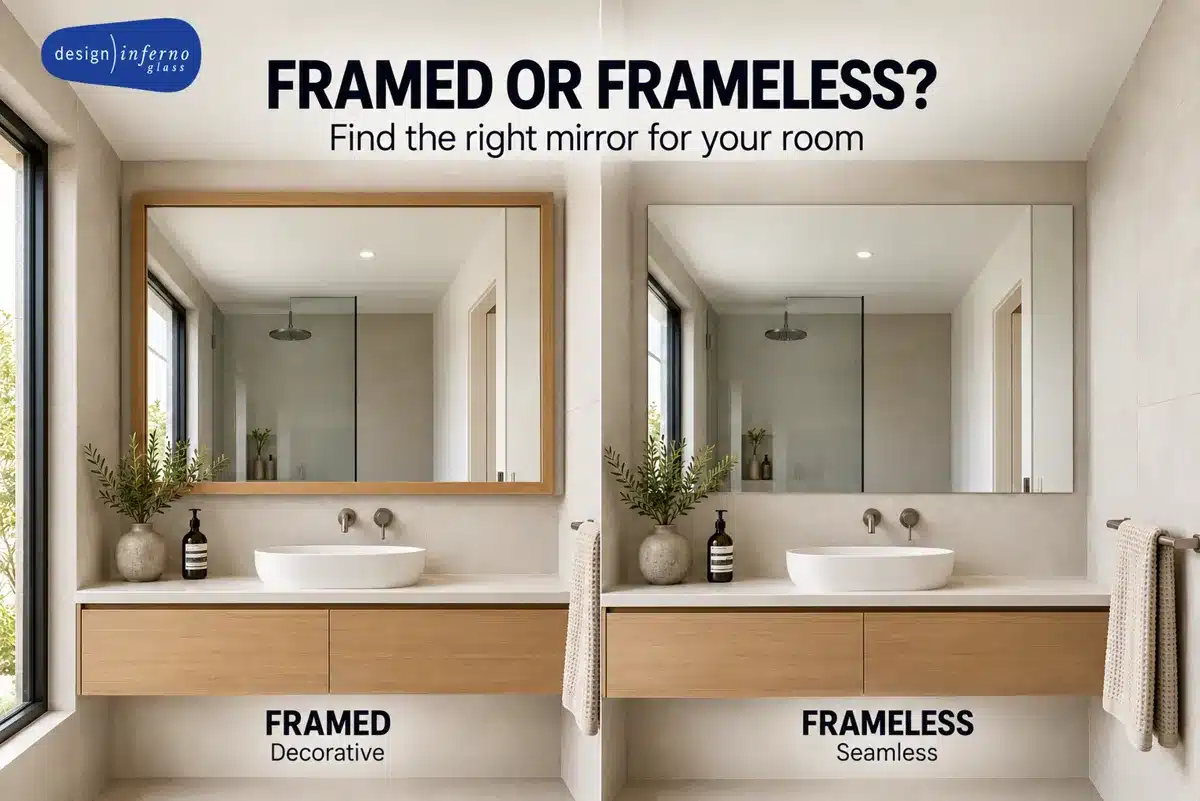
A framed wall mirror has a surrounding frame in timber, metal or a painted finish. A frameless wall mirror has an exposed polished or bevelled edge and no frame. Frameless suits minimalist rooms and small spaces because it reads as part of the wall. Framed mirrors suit rooms where the mirror should work as a decorative object.
Key takeaways
- Frameless mirrors recede into a wall and make a room look larger. Framed mirrors read as furniture.
- For bathrooms, ask for copper-free backing. It resists the black edge creep that ruins cheap mirrors.
- Safety-backed mirror holds fragments in place if the glass breaks, which matters on any large panel.
- Fixing method follows weight and wall type, not preference. Heavy mirrors need a stud or a rated anchor.
- Made-to-measure removes the compromise of a fixed retail size, in any shape including round and arch.
- Design Inferno lists wall mirrors from $350, made and installed from its Keilor Park factory.
Framed and frameless mirrors at a glance
| Attribute | Framed wall mirror | Frameless wall mirror |
|---|---|---|
| Edge treatment | Concealed by the frame | Exposed, polished or bevelled |
| Visual effect | Reads as a decorative object | Recedes into the wall, room looks larger |
| Style fit | Hamptons, heritage, industrial, traditional | Minimalist, contemporary, small spaces |
| Frame materials | Timber or wood, oak, black metal, brass, gold, white, aluminium | None |
| Edge finish options | Not applicable | Polished, bevelled or arrised |
| Moisture protection | Frame shields the mirror edge | Edge sealing and copper-free backing matter more |
| Typical glass thickness | 4mm to 6mm | 4mm to 6mm |
| Shapes available | Limited by frame construction | Rectangle, round, arch, oval, wavy, custom |
| Sizing | Often a fixed retail size | Cut to the exact wall dimension |
| Fixing | Hanging system or concealed cleat | Clips, J-channel, adhesive or concealed cleat |
| Where it is usually bought | Off the shelf from a retailer | Made to order by a glass manufacturer |
What is the difference between a framed and frameless mirror?
The difference is the edge. A framed mirror hides the glass edge inside a frame. A frameless mirror finishes the edge itself, so the glass is the whole product.
That single difference drives everything else. A frame adds material, depth and a style of its own. A framed mirror therefore behaves like a piece of furniture on the wall. A frameless mirror has no border between it and the surface behind. It behaves more like a window.
You may see frameless mirrors sold as unframed, borderless, polished edge mirrors or mirror wall panels. These all describe the same thing: a mirror finished at the edge rather than wrapped in a frame.
Polished, bevelled and arrised edges
A polished edge is ground flat and smooth. It is the standard finish on a frameless mirror. A bevelled edge is ground back at an angle around the perimeter, usually 10mm to 25mm wide. That angle catches light and adds a soft border without adding a frame. An arrised edge has the sharpness taken off only. It suits a mirror whose edge sits behind a clip or channel.
💡 GOOD TO KNOW
A bevel is the usual answer when a room wants a little decoration but a frame would be too heavy. It gives the mirror a visible border while keeping the seamless frameless look.
Do frameless mirrors make a room look bigger?
Yes. A frameless mirror reflects the room without a visual border. The eye reads the reflection as continued space rather than as a framed picture.
Two things create the effect. The mirror doubles the light already in the room, natural and artificial. That lifts a dark hallway or a small bathroom. The absence of a frame then removes the line that tells the eye where the wall stops.
Size matters more than style here. A mirror that is visibly too small for its wall looks like an accessory, whatever finish it has. Made-to-measure glass lets the mirror fill the space it was meant to fill.
Choose a frameless mirror when
- The room is small or narrow
- The look is minimalist or contemporary
- The mirror needs to fill a wall exactly
- You want a shape a frame cannot follow
- The mirror sits above a vanity or bench
Choose a framed mirror when
- The mirror should be a feature in itself
- The room has a heritage or Hamptons style
- A frame ties into existing timber or metal
- The mirror hangs on a large blank wall
- The edge needs protecting from splashing
Which is better for a bathroom, framed or frameless?
Either works, but the backing matters more than the frame. Ask for copper-free mirror backing in any bathroom, ensuite or powder room.
Bathroom mirrors fail at the edges first. Moisture works into the silvering and leaves the black creeping marks seen on older mirrors. Copper-free backing resists that corrosion. It is the wet-area specification, not an upgrade.
A frame helps by shielding the edge from direct splashing. A frameless mirror in the same position relies on correct edge sealing and the right backing instead. Both approaches work when specified properly.
Design Inferno lists bathroom mirrors with LED backlighting and defogging, and the same glass is used for bathroom projects that also include frameless shower screens.
⚠️ SPECIFY THIS FOR WET AREAS
- Copper-free backing to resist silver edge corrosion
- Sealed edges where the mirror meets a splashback or benchtop
- A demister pad if the mirror sits opposite a shower
- Cutouts confirmed before manufacture for tapware, lights or a shaving cabinet
Are wall mirrors safe?
Safety-backed mirror carries a backing film that holds fragments in place if the glass is broken, which is the specification to ask for on any large panel or any mirror in a high-traffic area. Safety glazing materials used in Australian buildings are manufactured to AS/NZS 2208, and glass selection and installation in buildings is covered by AS 1288:2021, which supersedes the 2006 edition and is a primary reference for the National Construction Code.
Which mirror suits each room?
Frameless suits bathrooms, small rooms and gyms. Framed suits bedrooms, hallways and living rooms where the mirror is meant to be noticed.
| Room | Usually better | Why |
|---|---|---|
| Bathroom or ensuite | Frameless | Fills the vanity width exactly, no frame to trap moisture, suits LED and demister |
| Powder room | Framed | Small feature wall where a frame gives the room a focal point |
| Bedroom | Either | Framed as a dresser piece, frameless full-length for a wardrobe wall |
| Hallway or entryway | Framed | Reads as a deliberate object in a space with little else on the walls |
| Living or dining | Framed | Ties into existing timber, metal or joinery finishes |
| Home gym | Frameless | Wall-to-wall panels with no frame lines interrupting the reflection |
| Small or narrow room | Frameless | No border, so the reflection reads as continued space |
| Retail fit-out | Frameless | Clean, repeatable panels that suit a commercial finish |
Mirror is also used as a surface rather than an object. Mirrored glass wardrobe doors and a mirror glass splashback both use the same safety-backed glass as a wall mirror, cut to the opening instead of hung on the wall.
How do you hang a heavy mirror on a plaster wall?
Fix into a stud or use an anchor rated for the mirror’s weight. Plasterboard on its own will not hold a heavy mirror.
The fixing depends on two things: how much the mirror weighs, and what the wall is made of. Weight rises with size and glass thickness, so a full-length or wall-width mirror is heavier than it looks.
- Find the studs. Mark stud centres before deciding the mirror position, because the fixings need to land on them.
- Match the fixing to the substrate. Plasterboard needs a rated anchor or a stud. Brick and masonry need the correct plug. Tiled walls need drilling suited to tile.
- Choose the fixing type. Mirror clips and J-channel carry the mirror mechanically. A concealed cleat hides the fixing and spreads load. Adhesive is used with a mechanical fixing, not instead of one.
- Check the rating. Use the load rating supplied by the fixing manufacturer for that wall type. Do not estimate it.
- Level and pack. Uneven walls need packing behind the mirror so it sits flat and does not distort the reflection.
❌ AVOID THESE
- Hanging a heavy mirror on plasterboard with no stud or rated anchor
- Relying on adhesive alone on a large panel
- Fixing over an unsealed or bowed wall, which shows in the reflection
- Drilling a finished mirror on site, because the mirror is cut and finished before delivery
Can you get a mirror made to a custom size?
Yes. A custom mirror is cut to the exact dimensions of the wall, in rectangle, round, arch, oval, wavy or a shape drawn for the space.
This is the practical difference between a retail mirror and a made-to-measure one. A fixed size forces a compromise: too narrow above a vanity, or too short on a wardrobe wall. Cut-to-size removes the compromise and lets cutouts for power points, tapware or light fittings be fabricated before the glass is finished.
Design Inferno manufactures custom framed and frameless wall mirrors at its Keilor Park factory, in clear or low-iron glass, with timber, aluminium or custom frames.
How much does a custom wall mirror cost in Melbourne?
Design Inferno lists wall mirrors from $350. Price is quoted per job, because size, shape, edgework and backing all change the total.
There is no standard price per square metre for mirror, since a small bevelled round costs differently to a plain wall-width rectangle. Confirm current pricing when you enquire, because rates change. The drivers below are what move the number.
| Cost driver | What moves the price |
|---|---|
| Size | Larger panels use more glass and need more people to install |
| Shape | Round, arch and wavy shapes need shape cutting rather than a straight cut |
| Edgework | A bevelled edge costs more than a polished edge |
| Frame | Frame material and finish, or no frame at all |
| Backing | Copper-free backing for wet areas, and safety backing on large panels |
| Lighting | LED backlighting or a demister pad, which also needs an electrician |
| Cutouts | Each cutout for tapware, a power point or a light fitting adds fabrication |
| Installation | Wall type, access, working height and whether an old mirror is removed |
How are custom mirrors measured and installed?
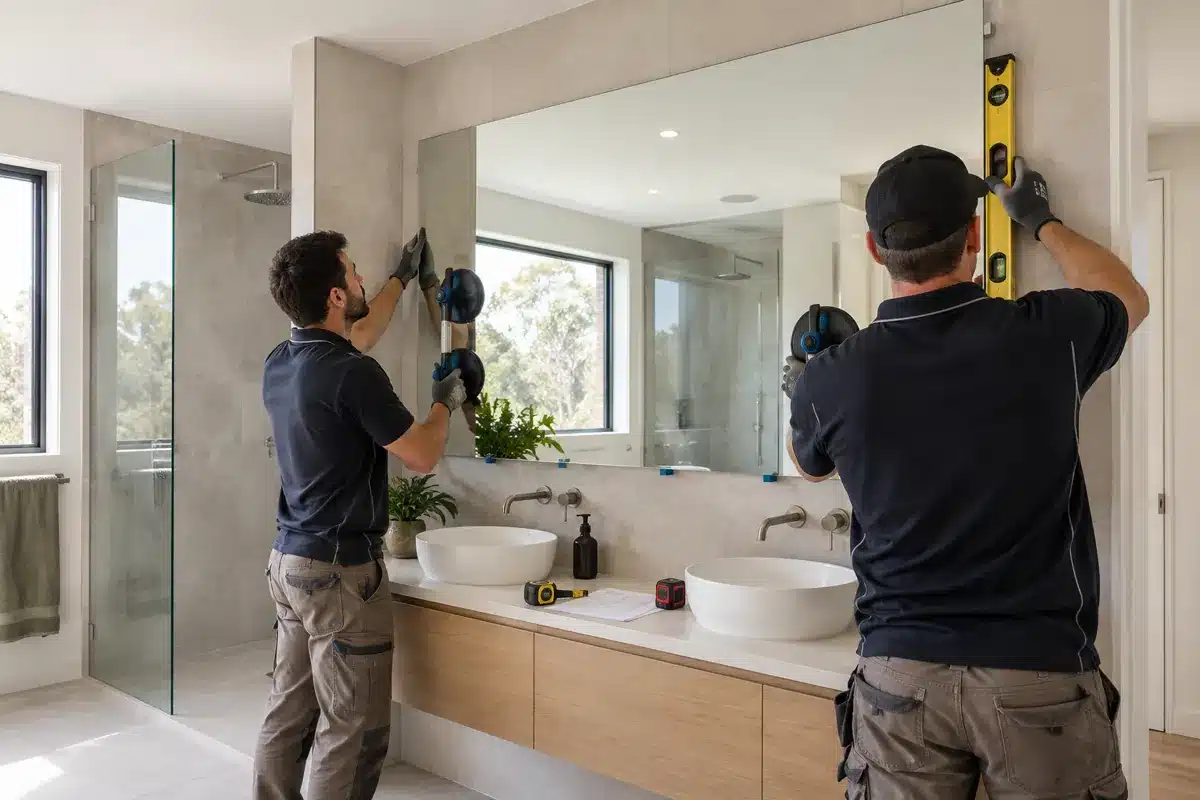
A glazier checks and measures the wall on site; the mirror is manufactured to those measurements, then it is fixed and levelled.
The mirror is cut, shaped and finished before it reaches the wall, so nothing is adjusted on site. The sequence runs as follows.
- Enquiry and quote. Supply rough sizes, photos or plans. Design Inferno offers free consultations and quotes.
- Style and finish selection. Framed or frameless, edge finish, shape, glass type and any lighting.
- On-site measurement check. A glazier measures the wall, records cutout positions and checks the substrate. Awkward shapes may be templated, which means taking a physical pattern.
- Manufacture. The mirror is cut to size or shape, the edge is polished or bevelled, cutouts are made, and the backing is applied.
- Installation. Fixings are set into studs or rated anchors, the mirror is packed level, and any edge sealing is completed.
⚠️ ORGANISE THESE EARLY
- Lighting and power point positions, because a lit mirror needs an electrician
- Whether a shaving cabinet, tapware or shelf will sit within the mirror area
- Wall preparation, since a bowed or unsealed wall shows in the reflection
Where can you get a custom mirror made in Melbourne?
Design Inferno designs, manufactures, supplies and installs custom wall mirrors across Melbourne from its Keilor Park factory and showroom.
The factory and showroom are at 48 Logistics Street, Keilor Park. Suburbs served include Essendon, Brunswick, Coburg, Moonee Ponds, Kew, Hawthorn, Doncaster, Point Cook and Williamstown.
Edge finishes are difficult to judge from a screen, so comparing a polished and a bevelled sample in person is worthwhile. Completed work is shown in the project gallery. Design Inferno has more than 15 years of industry experience across residential and commercial glass projects, and handles manufacturing, measurement and installation as one business.
The next step
Framed or frameless comes down to what the mirror should do in the room. Frameless when it should disappear into the wall and make the space feel larger. Framed when it should be noticed. The decisions that matter most are size, backing and fixing, and all three are settled before manufacture begins.
Measurements and pricing start with a site visit. Request a free quote to book a check measure with the Keilor Park team.
Frequently asked questions
No, but keep cleaner away from the edges. Spray the cloth rather than the mirror, so liquid does not pool at the perimeter and work into the backing. A streak-free glass cleaner and a microfibre cloth are all a frameless mirror needs.
Moisture reaches the silvering at the edge and corrodes it. Copper-free backing resists this, and correct edge sealing keeps water out in the first place. Once the black marks appear, they cannot be cleaned off, because the damage is behind the glass.
Yes. Round, arch, oval and wavy shapes are all cut to order, and a shape can be drawn to suit a specific wall. Shape cutting costs more than a straight cut, and the edge is polished or bevelled to follow the curve.
Small mirrors can be hung by a competent DIYer. Large, heavy or wet-area mirrors are worth installing professionally, because the fixing has to suit the weight and the wall, and a finished mirror cannot be trimmed or drilled on site if something does not fit.
Yes. Design Inferno lists bathroom mirrors with LED backlighting and defogging. Both need power, so a licensed electrician is involved and the position must be settled before the mirror is manufactured.
Edge finishes and frame options can be viewed at the Design Inferno showroom at 48 Logistics Street, Keilor Park. Comparing a polished edge beside a bevelled one in person is the quickest way to decide.
