
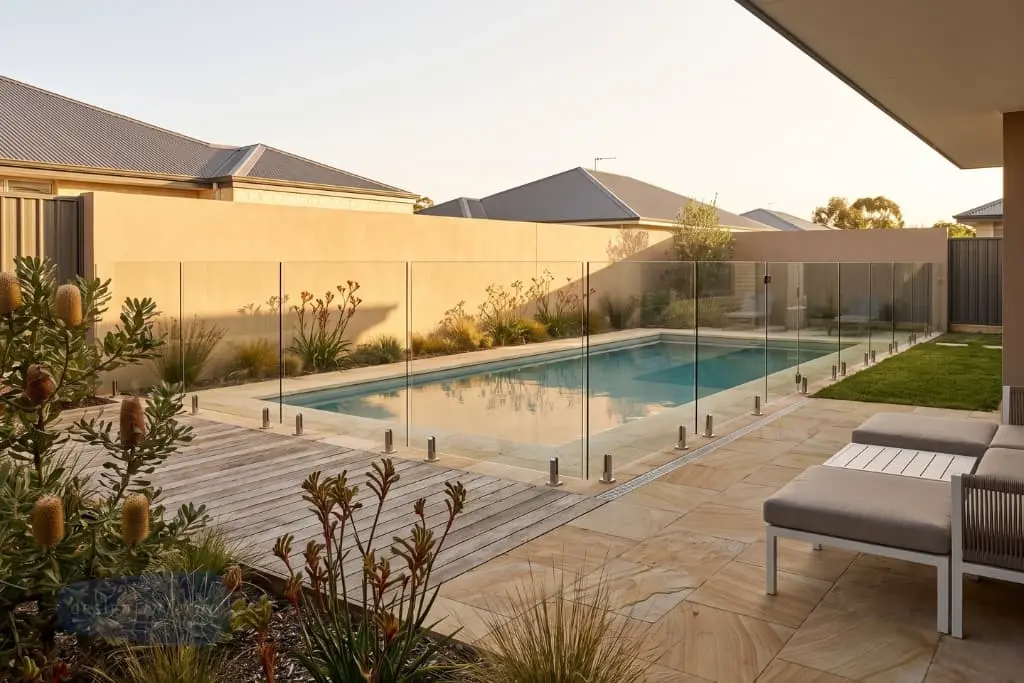
Choose frameless if you want the clearest view and the highest-end finish, semi-frameless if you want most of that look for less money, and framed if budget and strength matter more than sightlines. All three use toughened safety glass and all three can be made compliant. The real difference is how much metal you see, and what you pay for it.
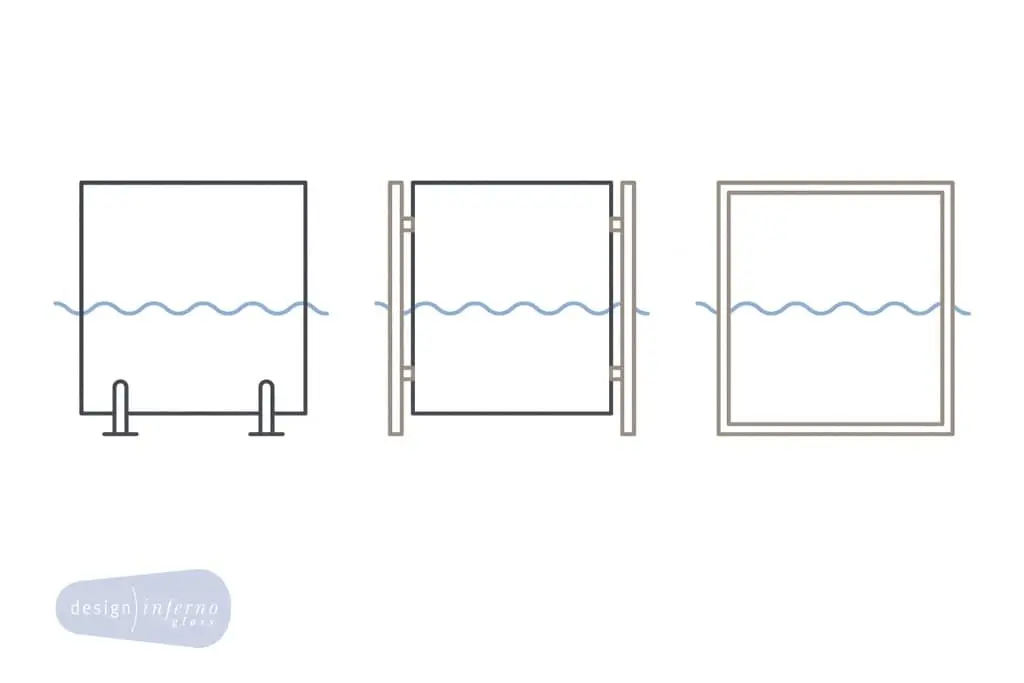
Key takeaways
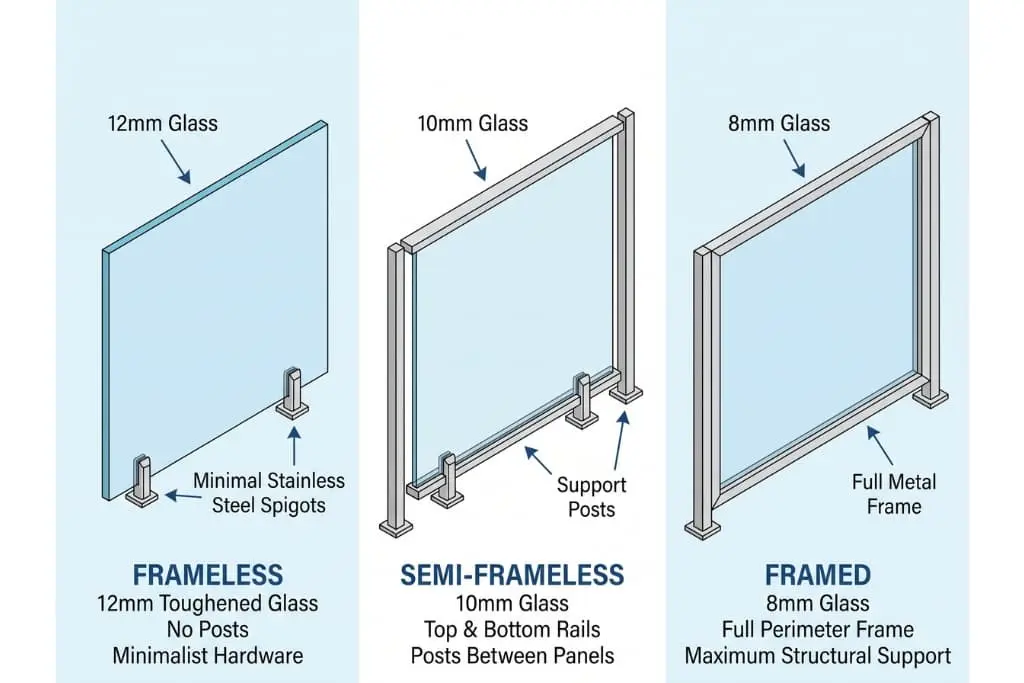
- Frameless panels sit on small floor-mounted spigots or in a channel, with no posts and no top rail.
- Semi-frameless keeps the open look but uses slim vertical posts, which cuts the cost.
- Framed panels sit inside an aluminium frame, which is the toughest and the cheapest of the three.
- All three types use toughened safety glass, so safety is not the thing that separates them.
- In Victoria, every pool barrier must comply with AS 1926.1-2012 and have self-closing, self-latching gates.
- You must register your pool with council and lodge a barrier compliance certificate every four years.
- Frameless glass is usually 12mm thick and needs a solid, level footing to sit on
What are the three types of glass pool fencing?
The three types are frameless, semi-frameless and framed, and they differ in how the glass is supported rather than what the glass is made of. Every panel is toughened safety glass. What changes is the hardware around it.
That single difference drives everything else: the price, the look from your back door, the way the fence is installed and how much cleaning it asks of you. Design Inferno makes all three types of glass pool fencing to measure at our Keilor Park workshop for pools right across Melbourne.
Toughened glass is heat treated so it is several times stronger than ordinary glass. If it ever breaks, it crumbles into small blunt pieces instead of long shards. That strength is what lets a pool fence panel stand up to weather, chlorine, pool chemicals and daily knocks year after year without a frame around it.
| Type | How the glass is held | What you see | Glass thickness | Relative cost |
|---|---|---|---|---|
| Frameless | Floor-mounted spigots or a channel | Glass only, no posts, no top rail | Usually 12mm | Highest |
| Semi-frameless | Slim vertical posts between panels | Glass with a thin post every panel | Usually 10mm to 12mm | Middle |
| Framed | Aluminium frame around each panel | A visible frame on all four sides | Thinner glass | Lowest |
What is frameless glass pool fencing?
Frameless glass pool fencing is a run of thick toughened panels held by small floor-mounted spigots or set into a channel, with no posts and no top rail. From a few metres away, the barrier almost disappears.
The panels are typically 12mm toughened glass, because the glass itself has to carry the load with nothing bracing the top edge. Each panel is fixed at the base by two or more spigots, usually stainless steel or powder coated, or dropped into a continuous channel that is set flush with the paving.
That is the whole appeal. You get an uninterrupted view of the pool from the house, the kitchen window and the entertaining area, so watching the kids swim never means peering through slats. A small courtyard also feels considerably larger when the barrier does not visually cut it in half.
There are trade-offs. Frameless is the dearest of the three, because thicker glass, precise cutting and machined hardware all cost more. Installation is less forgiving too: every panel has to be plumb and evenly spaced, and the footing underneath has to be solid and level. On soft ground or a new slab, that groundwork is part of the job.
Tip: Ask what the spigots are made of and how they are finished. Near salt water or a heavily chlorinated pool, cheap hardware is the first thing to show corrosion, long before the glass ever does.
What is semi-frameless glass pool fencing?
Semi-frameless pool fencing uses full height glass panels held between slim vertical posts, with no frame around the glass itself. It keeps most of the open feel of frameless at a lower price.
The posts do the structural work, so the glass can be a little thinner, and the footings do not need to be as precise. That is where the saving comes from. You still get large, clear panels and no top rail chopping across the view, just a slim upright every panel width.
For most backyards this is the practical middle ground. It suits sloping ground better than frameless, because each post can be set to its own height and the run can step down a grade neatly. It also handles slightly uneven paving without the whole line looking crooked. The trade-off is simple enough to weigh up in a sentence: a little more visible hardware, in exchange for a noticeably smaller invoice.
What is framed glass pool fencing?
Framed pool fencing sits inside an aluminium frame on all four sides of each panel, which makes it the strongest and most affordable of the three. You see the frame, but you also see the pool.
Because the frame carries the load, the glass can be thinner, and the whole system is more tolerant of movement, awkward ground and knocks. Frames are usually powder-coated aluminium, so you can pick a colour that matches your gutters, window frames or fence rather than fighting them.
Framed is the sensible pick for rental properties, holiday homes, budget-conscious builds and long fence runs where the cost difference across many panels adds up quickly. It is also the easiest to repair: a damaged panel comes out of its frame without disturbing the panels either side.
The obvious cost is the look. A frame around every panel breaks the view into sections and reads as fencing rather than as a design feature. For some homes that matters. For others, the money saved matters more.
Frameless vs semi-frameless vs framed: how do they compare?
Sightlines and price move in opposite directions. The less hardware you see, the more you pay, and every other difference follows from that.
| Frameless | Semi-frameless | Framed | |
|---|---|---|---|
| Visible hardware | Small base spigots only | Slim posts between panels | Full frame around each panel |
| View of the pool | Completely clear | Clear, broken by slim posts | Broken into framed sections |
| Typical glass thickness | 12mm | 10mm to 12mm | Thinner, frame carries the load |
| Installation tolerance | Low, needs level solid footings | Moderate | High, handles uneven ground |
| Suits sloping ground | Least | Well, posts step down | Well |
| Cleaning | More glass to keep clear | Slightly less | Least glass, but frames catch grime |
| Repair | Panel and hardware replaced together | Panel swapped between posts | Panel lifted out of its frame |
| Relative cost | Highest | Middle | Lowest |
| Best for | Feature pools, clear views, resale appeal | Most family backyards | Budget builds, long runs, rentals |
You can see our completed pool fencing work in the gallery.
What safety rules must a pool fence meet in Victoria?
Every pool and spa in Victoria that can hold more than 30cm of water needs a compliant safety barrier, and new barriers must comply with AS 1926.1-2012 with self-closing and self-latching gates. This applies whether or not children live at the property.
The rules sit in the Building Regulations 2018 and are enforced by councils. The Building and Plumbing Commission is the state regulator and publishes the current requirements.
What AS 1926.1-2012 requires
AS 1926.1-2012 is the Australian Standard for swimming pool safety barriers. The headline numbers are worth knowing before you get quotes, because they rule out some designs straight away.
- Minimum height of 1200mm measured on the outside of the barrier. Where a boundary fence forms part of the pool barrier, it must be 1800mm.
- Maximum gap of 100mm under the barrier, and no more than 100mm between vertical members or panels.
- A non-climbable zone of 900mm on the outside of the barrier, kept free of anything a small child could use as a foothold.
- Self-closing and self-latching gates that swing outwards, away from the pool area, and latch every time.
Glass panels help with two of these by their nature. There is nothing to climb on a sheet of glass, and a full height panel removes the horizontal rails that create footholds on a slat fence. The gaps between panels and under them still need to be right, which is where a careful install earns its money. Design Inferno pool fence panels are made to a standard height of 1200mm, with 900mm the recommended width for the gate.
Tip: The non-climbable zone is the most common reason a barrier fails an inspection, and it is almost never the fence itself. Pot plants, pool pumps, BBQs, chairs and garden beds pushed up against the outside of a glass panel will all fail you.
Registration and compliance certificates
Owning the pool comes with paperwork, not just a fence.
- Register the pool or spa with your council. This is mandatory for all pools and spas capable of holding more than 30cm of water, including relocatable and inflatable ones.
- Have the barrier inspected by a registered pool inspector, building inspector or building surveyor.
- Lodge the compliance certificate with council within 30 days of the date it is issued.
- Repeat every four years. A new certificate is required on a four-yearly cycle for the life of the pool.
Which barrier standard applies to an existing pool depends on when it was built, so the council will confirm the date of construction and the applicable standard when you register. The registration requirements page sets out the deadlines and the appeal process in full.
Behind the paperwork is the reason it exists. The Royal Life Saving National Drowning Report 2025 recorded 35 drowning deaths in swimming pools across Australia over the previous 12 months, and 68 per cent of those happened in backyard pools. The Building and Plumbing Commission adds that in the year to 30 June 2024, 15 children under the age of five drowned in Australia, half of them in private swimming pools. A compliant barrier is a backstop, not a substitute for watching young children around water.
What does glass pool fencing cost in Melbourne?
Glass pool fencing from Design Inferno starts from around $1,500, with the final figure driven by the type you choose, the length of the run, the number of gates and the ground you are fixing into. Every job is measured and quoted.
Roughly in order from cheapest to dearest, expect framed at the lower end, semi-frameless in the middle and frameless at the top. The gap comes from glass thickness and hardware more than labour, though frameless does take longer to set out on site.
Five things move a quote:
- Type and glass thickness. Frameless needs thicker glass and machined hardware, and both cost more per panel.
- Length of the run. More panels means more glass, more fixings and more setting out.
- Gates. Each gate needs compliant self-closing hinges and a self-latching catch, and gates cost more than a plain panel.
- Ground and fixings. A level concrete edge is straightforward. Pavers, decking, soft ground or a slope may need core drilling or new footings.
- Access. Narrow side gates, steep blocks and pools with no clear path to them all add time on site.
| Type | Where it sits on price | What drives the difference |
|---|---|---|
| Framed | Lowest | Thinner glass and simpler fixings, because the frame carries the load |
| Semi-frameless | Middle | Full height glass and slim posts, with less precise footings needed |
| Frameless | Highest | 12mm glass, machined spigots or a channel, and precise setting out on site |
Glass and hardware are quoted per panel or per metre, so a long run costs less per metre than a short one with two gates in it. Ask for the rate as well as the total, because that is the number that lets you compare quotes properly.
A measure and quote takes the guesswork out of it. Book a free consultation or call the Keilor Park showroom on 03 9336 7703. We measure and install across our Melbourne service areas.
Which type suits your backyard?
Start with the ground and the budget, then choose the look. Site conditions rule out more options than taste ever will.
| Your situation | Best pick | Why |
|---|---|---|
| Feature pool you want to see from the house | Frameless | Nothing interrupts the view from indoors |
| Small courtyard that feels tight | Frameless | The barrier visually disappears, so the space reads bigger |
| Standard family backyard, level ground | Semi-frameless | Most of the frameless look for less money |
| Sloping or stepped yard | Semi-frameless or framed | Posts and frames step down a grade cleanly |
| Long run around a large pool | Framed | The saving per panel adds up fast over distance |
| Rental or holiday property | Framed | Toughest, cheapest, easiest to repair panel by panel |
| Coastal or salt chlorinated pool | Any, with upgraded hardware | Fixings matter more than fence type near salt |
| You want privacy on one side | Any, with an obscured panel | Frosted or tinted glass blocks the view without blocking light |
Colour is the last filter. Spigots, posts and frames come in different finishes, and the right one usually takes its cue from your paving, gutters and window frames rather than from the pool. Screens are unreliable for this, so ask for physical samples of the spigots, posts or frame colour before you decide. Matching the fence hardware to the other metalwork around the pool area, such as handrails, gates and light fittings, keeps the whole yard looking deliberate rather than assembled in stages.
How do you keep a glass pool fence looking good?
Rinse the panels with fresh water, wash them with warm soapy water and a soft cloth, then squeegee dry. That is the whole routine, and doing it monthly is enough for most pools.
Glass shows water marks more than a slat fence does, particularly on the side that catches pool splash. Hard water and chlorine leave mineral deposits that etch into the surface if you leave them for months, so a quick rinse after a big weekend is worth more than a deep clean twice a year.
- Avoid abrasive pads, scourers and harsh solvents. They scratch the glass and strip the finish off spigots and frames.
- Check the hardware, not just the glass. Twice a year, test that the gate still swings shut and latches by itself from any open position.
- Look at the fixings. Any rust staining, loose bolts or movement in a panel should be dealt with straight away, not at the next four-yearly inspection.
- Keep the outside clear. Anything stored against the fence undoes the non-climbable zone, and it is the easiest thing in the world to forget.
There are more answers on our frequently asked questions page and across the Design Inferno blog.
Frequently asked questions
Frameless panels sit on small floor-mounted spigots or in a channel, with no posts at all. Semi-frameless panels are held between slim vertical posts. Both leave the glass unframed and give a clear view, but semi-frameless costs less and copes better with sloping ground.
Yes. Frameless panels use thick toughened safety glass and must meet AS 1926.1-2012 like any other barrier. Toughened glass crumbles into small blunt pieces rather than sharp shards if it ever breaks, and a smooth full height panel gives a child nothing to climb.
Frameless panels are usually 12mm toughened glass, because the glass carries the load on its own. Semi-frameless panels are commonly 10mm to 12mm. Framed panels can be thinner, since the aluminium frame does the structural work.
At least 1200mm measured on the outside of the barrier, under AS 1926.1-2012. Where a boundary fence forms part of the pool barrier, it must be 1800mm high, and gaps under or between panels must not exceed 100mm.
Yes. You must register the pool or spa with your council, have the barrier inspected, and lodge a barrier compliance certificate with council within 30 days of it being issued. A new certificate is required every four years.
Framed. The aluminium frame lets you use thinner glass and simpler fixings, so the cost per panel is the lowest of the three. Semi-frameless sits in the middle and frameless is the dearest.
Not as a rule. A frameless barrier is designed to work without a top rail, which is exactly why it looks the way it does. Some designs and site conditions call for one, so confirm it with your installer and building surveyor.
Toughened glass itself lasts decades outdoors. What ages is the hardware, so the finish and quality of spigots, posts, hinges and latches is the real driver of how long the fence looks and works well.
In Victoria, pool safety barriers must be constructed by a builder registered in an appropriate category or by an owner-builder holding a certificate of consent. The barrier also has to pass an inspection before a compliance certificate can be issued, so professional installation is the safer path.
