
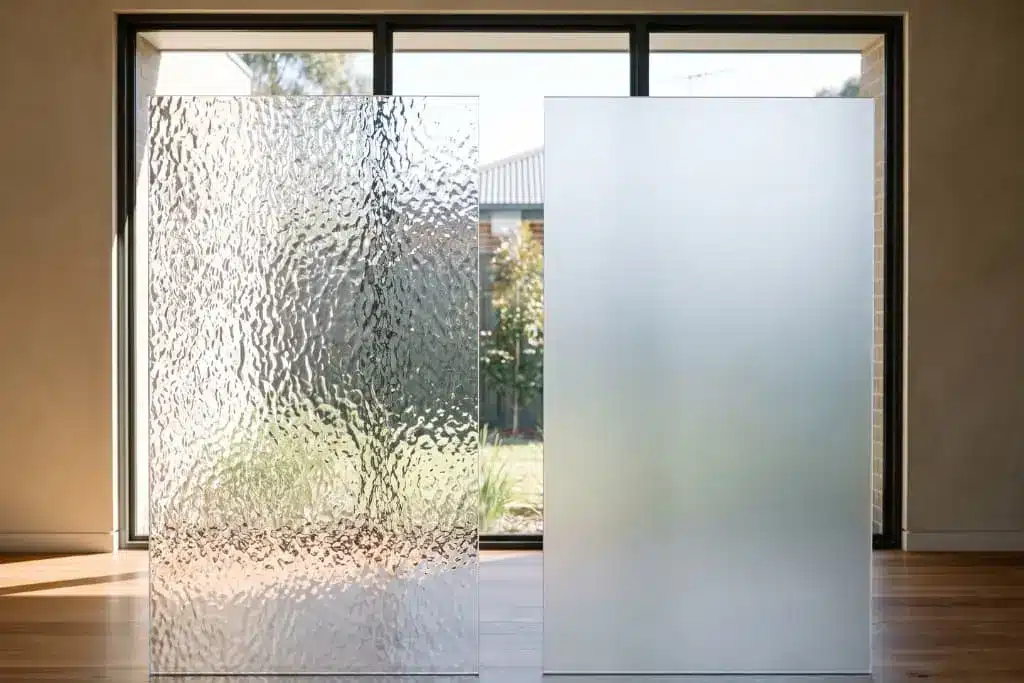
Textured glass has a pattern pressed or kiln formed into the surface, so it obscures through shape and depth. Frosted glass is acid etched or sandblasted, giving a flat, even satin finish that obscures through haze. Textured suits decorative panels and feature work. Frosted suits clean, modern privacy. Both can be toughened to Grade A safety glass.
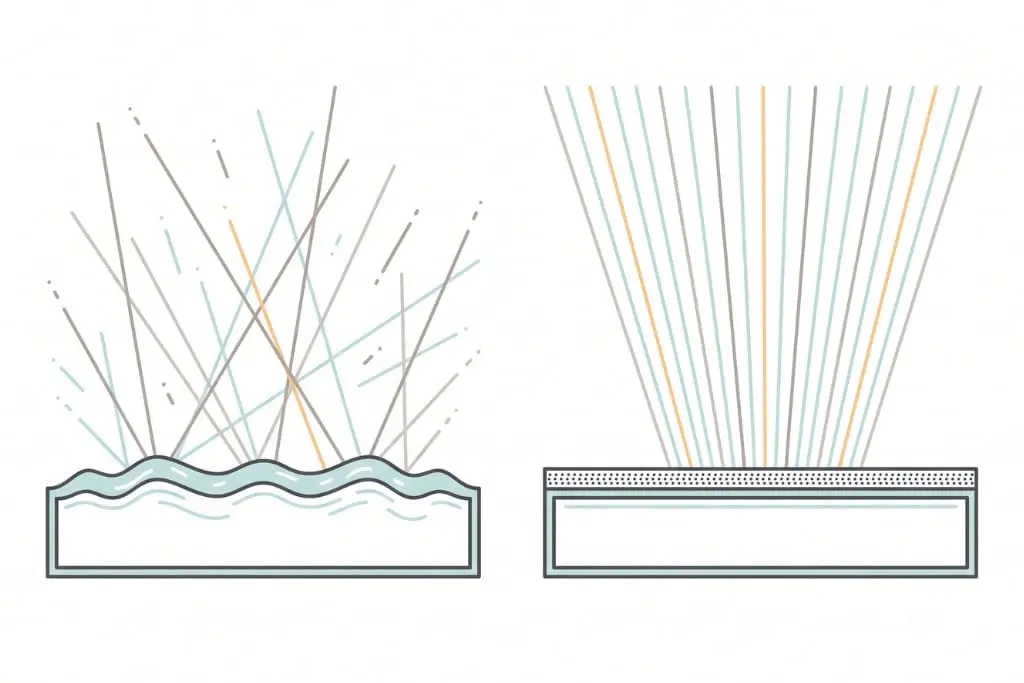
Key takeaways
- Textured glass obscures with shape and depth. Frosted glass obscures with an even haze.
- Textured glass is rolled between patterned rollers, or kiln formed at 650°C to 700°C for custom work.
- Frosted glass is acid etched across the whole sheet, so the finish is consistent edge to edge.
- Frosted glass can transmit up to 87.5 per cent of light while still diffusing it.
- Textured glass hides fingerprints and water marks better because the surface is not flat.
- Acid etched glass has a right way round. The etched face must be glazed away from moisture.
- Both finishes become Grade A safety glass once toughened, which AS 1288:2021 requires in bathrooms, doors and shower screens.
- Slumped textured glass from Design Inferno starts from $400, custom made in Melbourne and professionally installed.
How is each finish actually made?
Textured glass is shaped while the glass is hot. Frosted glass is treated after the glass has cooled. That single difference explains almost everything else about how the two behave.
How is rolled patterned glass made?
Standard patterned glass is made by passing a continuous ribbon of molten glass between two rollers. One roller carries a pattern, and it presses a permanent impression into the surface as the ribbon passes through. Viridian makes its DécorPattern range this way, in patterns such as Cathlite, Satinlite, Spotswood and Narrow Reeded, at 4mm, 5mm and 6mm.
Because the pattern is part of the glass, it cannot wear off, peel or scratch away. Viridian lists the range as easy to clean and resistant to marking and scratching, which is what you would expect from a surface formed in the melt.
What is slumped glass, and how is it made?
Slumped glass is the custom end of textured glass. A flat sheet is laid over a mould and heated in a kiln to between 650°C and 700°C until it softens and settles into shape. The result is deeper and far more three dimensional than a rolled pattern. The mould is made to a design rather than chosen from a catalogue.
This is the process behind our slumped and textured glass work. The shape, the thickness and the pattern are all specified per job, and the glass is toughened so it meets Australian safety standards.
What is acid etched frosted glass?
Frosted glass is most often float glass with one face treated with an acid etch. The treatment is applied to the whole sheet after manufacture, which is what gives it a consistent finish rather than the patchy look of a spray on product. Viridian’s DécorSatin is made this way, and the finish is both moisture resistant and UV resistant.
The important detail is that only one face is etched. That face has to be installed the right way round, which we come back to below.
Are sandblasting and frosting film worth considering?
Sandblasting is the other way to frost glass. Abrasive grit is fired at the surface under pressure, usually through a stencil, so it can produce logos, borders and partial patterns that an all over etch cannot. The trade off is a more open, more porous surface that holds marks and needs more careful cleaning.
Frosting film is a self adhesive vinyl applied to clear glass. It is the cheapest option by a wide margin and it is genuinely useful in rentals. It is not glass though. It scratches, it lifts at the edges over time, and it will never look like an etched panel up close.
Tip: If a quote says “frosted” without saying how, ask. Acid etched, sandblasted and film are three very different products at three very different prices.
Textured glass vs frosted glass at a glance
Textured wins on character and on hiding marks. Frosted wins on consistency and on a clean, quiet look. Neither is better across the board.
| What you are comparing | Textured glass | Frosted glass |
|---|---|---|
| How it obscures | Shape and depth distort the view | An even haze scatters the view |
| Surface | Three dimensional, raised and recessed | Flat, smooth, matte |
| Look | Decorative, tactile, a feature in itself | Minimal, uniform, recedes into the room |
| Consistency panel to panel | Varies with the pattern and the mould | Identical across every sheet |
| Hides fingerprints and water marks | Very well | Poorly on the etched face |
| Light quality | Broken and directional, with visible sparkle | Soft and evenly diffused |
| Custom design | Excellent with kiln forming | Limited to stencilled sandblasting |
| Sides treated | Usually one face, sometimes both | One face only when acid etched |
| Typical cost | Higher, especially custom slumped work | Moderate, and predictable |
| Best suited to | Feature panels, screens, decorative work | Bathrooms, doors, partitions, offices |
Which one gives you more privacy?
Frosted glass gives more consistent privacy. Textured glass can give more privacy, but only with a deep pattern. Obscuration is not a single number, and it changes with distance and with light.
A frosted panel blurs everything behind it to a soft shape. It does that identically across the whole sheet, and it does it the same way at every distance. That predictability is why it dominates bathroom windows and toilet doors.
Textured glass is more variable. A deep, heavily rippled pattern can obscure more than an etched panel. A light pattern such as a fine reeded or a subtle cathedral texture may only break up an outline. Someone standing close to the glass will still read shapes and movement clearly.
How much does viewing distance change privacy?
More than the pattern does, in most cases. Both finishes obscure far more the further the subject stands from the glass. Use this as a rough guide when you are holding a sample.
| Distance from the glass | Frosted glass | Light textured pattern | Deep textured pattern |
|---|---|---|---|
| Touching the glass | Shape and colour readable | Detail readable | Shape readable |
| About half a metre | Soft outline, no detail | Outline and movement clear | Broken outline |
| One to two metres | Blurred shape only | Outline still visible | Little more than movement |
| Over two metres | Movement only | Soft outline | Movement only |
Reeded and ribbed textures behave differently again. They distort horizontally but not vertically, so a person walking past a reeded panel is far more obvious than a person standing still.
Why does obscure glass fail at night?
Because privacy glass only works while the lit side is the side you are looking from. At night, with a light on inside and darkness outside, both finishes give away much more than they do in daylight. If the room is overlooked and used after dark, plan for a blind or a deeper obscuration level rather than relying on the glass alone.
Tip: Ask for a sample large enough to hold at arm’s length, then look through it at a person two metres away. A 100mm swatch held against your eye tells you almost nothing about real privacy.
Which finish lets in more light?
Frosted glass generally lets through more light. Textured glass gives more interesting light. The measurable difference is smaller than most people assume.
Viridian rates DécorSatin at up to 87.5 per cent light transmission while still diffusing the view. That is a lot of daylight for a panel you cannot see through, and it is why acid etched glass suits south facing rooms and internal spaces that borrow light from elsewhere.
Textured glass scatters light rather than simply softening it. The raised and recessed surface refracts daylight in different directions, so a textured panel throws highlights, sparkle and moving shadow onto the surfaces around it. A slumped panel near a window becomes a light feature in its own right.
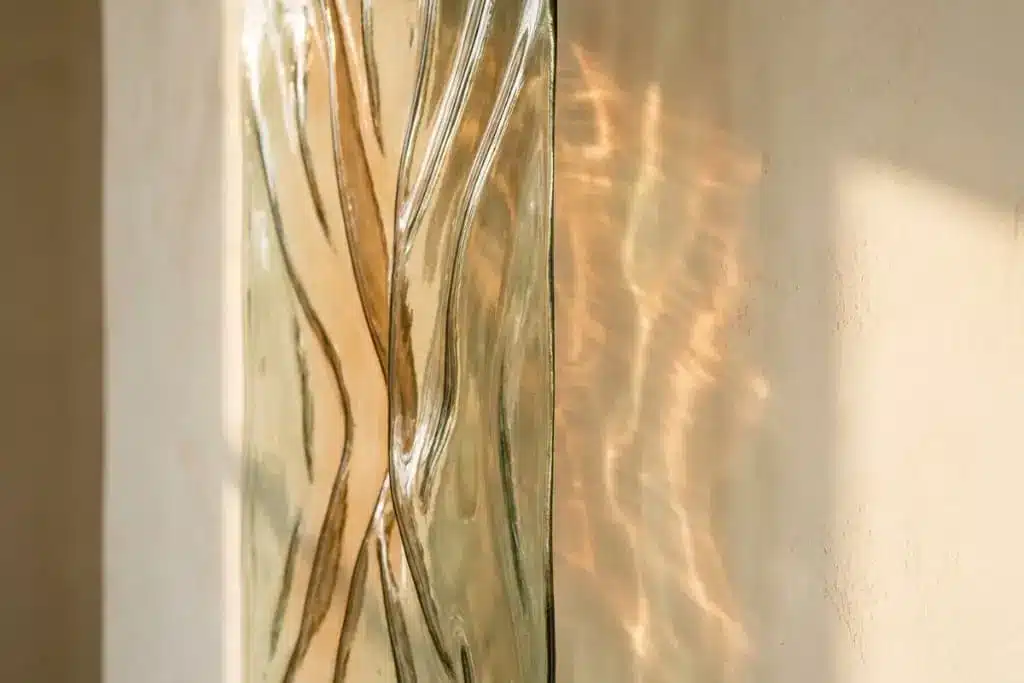
Which you want depends on the job. For a work area, a laundry or a home office, even diffused light is easier to live with. For an entry, a stair void or a feature wall, broken light is the whole point.
Which is easier to keep clean?
Textured glass hides marks better. Frosted glass shows every fingerprint on the etched face. Both clean with the same method, so the difference is how often you notice they need it.
A textured surface has no flat plane for a fingerprint to sit on, so marks break up visually before you register them. Water spots do the same. Viridian describes its rolled patterned range as easy to clean and resistant to marking, and in a busy kitchen or hallway that shows.
Acid etched glass is the opposite. The finish is even, so anything on it reads as a shadow against a uniform background. Oils from skin are the worst offender. They soak slightly into the etched surface and need a solvent rather than water to lift.
Which way round should frosted glass be installed?
With the etched face inside, and away from the water. Viridian is explicit that the etched surface must be glazed to the inside of the building, and that it must face away from moisture exposed areas. Get this backwards in a bathroom and the etched face takes the steam, the soap and the shampoo directly. It will stain, and it is very difficult to bring back.
Sandblasted glass is more porous again, and it is the least forgiving of the three. Some suppliers apply a protective coating for this reason, and it is worth asking whether yours has one.
| Finish | How it handles marks | How to clean it |
|---|---|---|
| Rolled textured | Hides fingerprints and water marks well | Warm water, a drop of dishwashing liquid, soft brush in the grooves |
| Slumped textured | Hides marks very well, deep recesses hold dust | Same, with a soft brush and a dry buff |
| Acid etched frosted | Shows fingerprints and oils clearly | Methylated spirits on a damp cloth, then buff dry |
| Sandblasted | Shows and holds marks the most | Solvent on a cloth, never abrasive, ask about a sealer |
| Frosting film | Marks like plastic, scratches permanently | Damp cloth only, no solvents, no scrubbing |
The Australian Glass and Window Association recommends cleaning glass with a few drops of methylated spirits on a damp cloth, then polishing dry with a lint free cloth. It also warns that some proprietary glass cleaners can damage the interlayer in laminated glass, so the mild approach is worth defaulting to on any decorative panel.
Tip: Never take a scourer or a bladed scraper to either finish. On textured glass it dulls the high points. On etched glass it leaves a permanent shiny streak that catches the light forever.
Where does each finish work best in a Melbourne home?
Use frosted glass where privacy is the job and the glass should disappear. Use textured glass where the glass is meant to be seen. Most homes end up with both.
| Where it goes | Better choice | Why |
|---|---|---|
| Bathroom or toilet window | Frosted | Consistent obscuration, etched face turned away from the steam |
| Shower screen panel | Frosted or lightly textured | Privacy without closing the room in, easy to squeegee |
| Internal door or sidelight | Frosted | Clean look, predictable privacy, borrows light between rooms |
| Entry feature panel | Textured | The panel is the first thing a visitor sees |
| Stair void or void screen | Textured | Broken light does the most work in a tall space |
| Office or study partition | Frosted | Quiet, uniform, keeps the room reading as one space |
| Feature wall or hallway panel | Textured | Depth and shadow give a flat wall something to do |
| Laundry or pantry door | Frosted | Hides contents evenly without drawing attention |
| Water feature or garden screen | Textured | Movement in the surface suits movement in water and planting |
| Rental or short term fix | Frosting film | Reversible, cheap, no glazing work |
Which finish suits an older Melbourne home?
Textured, in almost every case. Federation and interwar houses often have original cathedral or reeded glass in front doors and hallway sidelights. Matching a textured pattern to that existing glazing keeps the character intact. A modern flat frosted panel next to it will always look like a repair.
If the original glass is broken and the pattern is no longer made, a custom mould can reproduce the scale and rhythm of it closely enough that the difference is invisible from a metre away. Bring a piece of the old glass, or a clear photograph with something in it for scale.
You can see textured and slumped glass we have made for homes across Melbourne in the gallery.
Is each finish safe for bathrooms, doors and screens?
Only if it is Grade A safety glass. Neither texturing nor frosting makes glass safe on its own. Toughening does.
Under AS 1288:2021, glazing in areas subject to human impact must be Grade A safety glass. The Australian Glass and Window Association lists those areas as doors, sidelights, stairs and landings, kitchens and bathrooms. Safety glazing materials are made to AS 2208, and safety glass carries a legible mark so it can be identified after installation.
Both finishes can meet that requirement. Viridian confirms that DécorPattern and DécorSatin are each Grade A safety glass once toughened. Slumped glass made by Design Inferno starts as toughened glass, which is why it can be used for shower screens and doors as well as decorative panels.
What should you check before you specify a pattern?
Two things catch people out.
- Some patterns are directional. Rolled patterned glass is often supplied in one orientation only, so panels must be planned and cut with that in mind.
- Non standard thicknesses limit the fixings. Viridian notes that Narrow Reeded, at 6mm, is not recommended for frameless applications. Thickness drives what the glass can be fixed with, not just how strong it is.
Shower screens carry an extra layer. As well as AS 1288, they fall under AS 3740 for waterproofing of domestic wet areas, which governs the water stop angle and the waterproofing around the screen rather than the glass itself.
What does textured or frosted glass cost?
Frosted glass is the more affordable and more predictable of the two. Custom slumped glass sits at the top of the range and starts from $400. Size, thickness, toughening and installation move every figure.
Rolled patterned glass and acid etched glass are both stock products, so they are priced much like clear glass with a modest premium. Sandblasting adds labour, and a stencilled design adds more. Kiln forming is a different category altogether, because a mould has to be made and the panel is heated and cooled on its own cycle.
| What drives the price | Effect on cost |
|---|---|
| Stock pattern or etch vs custom mould | The single biggest factor |
| Panel size | Rises faster than the area, and large panels need two installers |
| Thickness | Thicker glass costs more and weighs more to handle and fix |
| Toughening | Required for bathrooms, doors and screens, and not optional there |
| Cut outs and holes | Must be done before toughening, so changes later mean a new panel |
| Frameless vs framed fixing | Frameless needs thicker glass and more precise fixings |
| Installation access | Stairs, voids and tight bathrooms all add time |
Our slumped and textured glass starts from $400, with the shape, thickness and pattern specified for each job and every panel made in toughened glass. Every project is measured and quoted, because a custom mould makes a catalogue price meaningless.
Book a free consultation or call the Keilor Park showroom on 03 9336 7703. We measure and install across our Melbourne service areas, and every panel is made at our own workshop.
How do you choose between them in five steps?
Work out the job first, then the room, then the look. Choosing on appearance alone is how people end up with a beautiful panel that gives them no privacy.
- Name the actual job. Privacy, decoration, light control or all three. If privacy is the only job, frosted is usually the answer and you can stop here.
- Check the viewing distance. Under a metre, you need a deep texture or a full etch. Over two metres, almost any obscuring finish works.
- Check the moisture. In a wet area, an acid etched face has to be turned away from the water. If it cannot be, choose textured instead.
- Check the standard. Doors, bathrooms, kitchens, stairs and screens all need Grade A safety glass under AS 1288:2021. Confirm the finish you want can be toughened.
- Look at a full size sample in the room. Hold it where the glass will go, at the time of day the room is used most. Patterns look completely different in a showroom.
Tip: Get the sample against the light you will actually have. A north facing room in Melbourne in July and the same room in January are two different rooms.
Five things people get wrong about these finishes
Most bad decisions here come from four or five very common assumptions. They are worth naming.
| The assumption | What is actually true |
|---|---|
| Frosted and textured mean the same thing | One is a surface treatment, the other is a change in shape. They behave differently |
| Frosted glass is completely private | It blurs. Up close, and at night with a light on, it still gives a lot away |
| Any pattern gives privacy | Light patterns break up an outline without hiding it. Obscuration varies enormously |
| Frosting film is the same as etched glass | Film scratches, lifts at the edges and never matches an etched panel up close |
| Frosted glass can be turned either way | Acid etched glass has one treated face, and it must be glazed away from moisture |
Can you use both finishes together?
Yes, and it usually works better than choosing one. The trick is giving each finish a clear role.
A common pattern in a Melbourne renovation is frosted glass everywhere privacy is functional, and one textured panel where the eye lands. A frosted bathroom window and a slumped feature panel in the entry, for example, read as one considered decision rather than two competing ones.
What does not work is mixing them within the same sightline for no reason. Two different obscuring finishes visible at once look like a change of mind, especially in an open plan space.
More short answers sit on our frequently asked questions page and across the Design Inferno blog.
Frequently asked questions
No. Frosted glass is smooth glass that has been acid etched or sandblasted, so it obscures through an even haze. Textured glass has a pattern rolled or kiln formed into it, so it obscures through shape and depth. They look, feel and clean differently.
Frosted gives more consistent privacy, because the finish is identical across the panel. Textured can give more privacy, but only with a deep pattern. A light texture may break up an outline without hiding movement, so always test a sample at the real viewing distance.
More than you can in daylight. Any obscuring glass works by scattering light, so when the inside is lit and the outside is dark, shapes and movement become much clearer. If the room is overlooked and used after dark, add a blind or choose a deeper obscuration level.
It shows marks more. The etched face is uniform, so fingerprints and skin oils stand out against it, and they usually need methylated spirits on a damp cloth rather than water. Textured glass hides the same marks because there is no flat plane for them to sit on.
Yes, when it is acid etched. Only one face is treated, and Viridian specifies that the etched surface must be glazed to the inside of the building and turned away from moisture exposed areas. Installed the wrong way in a bathroom, the etched face will stain.
Both are, once toughened. AS 1288:2021 requires Grade A safety glass in areas subject to human impact, and the Australian Glass and Window Association lists bathrooms, doors, kitchens, stairs and landings among them. Toughened patterned and toughened acid etched glass both qualify.
Yes. Slumped and patterned glass can be used in shower screens provided it is toughened and the fixings suit the thickness. Some rolled patterns are not made in standard thicknesses, and those are not recommended for frameless fixing, so confirm the pattern before you design the screen.
Up to 87.5 per cent, on Viridian’s figure for its acid etched DécorSatin range, while still diffusing the view. That is close to clear glass, which is why an etched panel can give full privacy in a small bathroom without making it feel dark.
Design Inferno slumped glass starts from $400, and the final figure depends on the size, the thickness, the complexity of the mould and the installation. Because each mould is made for the job, a measure and quote is the only accurate way to price it.
For a rental or a short term fix, yes. It is cheap and it is reversible. It is not comparable to etched or textured glass in appearance or durability, because it scratches, it lifts at the edges over time and it reads as plastic at close range.
Existing glass can be sandblasted or filmed in place or in a workshop, but it cannot be acid etched or kiln formed after installation. Rolled patterns and slumped textures are both created while the glass is being made, so those mean a new panel.
Textured, in almost every case. Federation and interwar houses usually have original cathedral or reeded glass in the front door and hallway sidelights, and a flat frosted panel next to that reads as a repair. A custom mould can reproduce the scale of an original pattern closely.
